For buyers comparing Torque Fitness strength equipment, the best choice depends less on a single measure of strength and more on how you want to train. I’d start with the TANK M1 Push Sled for versatile, quiet resistance without a fixed mounting point, choose the Relentless Ripper Ski Machine for structured workouts and performance metrics, or pick the Relentless Rope Trainer for fast, effort-driven rope work on an existing rack.

Get workout gear delivered free with Prime
- Fast, free delivery on millions of items
- Prime Video, Amazon Music and more included
- Member-only deals all year
These three options solve different space and programming problems. The M1 is a manually pushed sled that can move between suitable training surfaces, but its 67-pound frame is not especially light to carry. The Ripper offers more resistance settings and a monitor, though it needs a compatible mounting surface and corded power. The Rope Trainer is mechanically simpler and supports bi-directional pulls, but it also depends on rack or rig compatibility, unless you add its separate wall-mount bracket. I rank them by how broadly each can fit a strength-training setup, how much training variety it offers, and how many practical conditions a buyer must meet.
Complete the kit



Key Takeaways
- TANK M1 is my most flexible pick if you want a manual sled that does not require a rack, rig, or wall mount.
- Relentless Ripper suits buyers who want ten resistance levels and workout data, provided a compatible mounting point and corded power are available.
- Relentless Rope Trainer is the focused choice for bi-directional rope work, with resistance responding to pulling speed and effort.
- Mounting is the main dividing line: the M1 can be used on suitable surfaces, while both Relentless products require compatible mounting arrangements.
- The lineup favors different training styles rather than interchangeable machines: sled pushes, rope pulls, and ski-style movements call for distinct programming.
| Torque Fitness TANK M1 Push Sled |  | Best Overall | Item type: Push sled | Operation: Manual | Resistance: Mag-Force variable-resistance brake | VIEW LATEST PRICE | See Our Full Breakdown |
| Torque Fitness Relentless Ripper Ski Machine |  | Best for Structured, Metric-Tracked Workouts | Resistance: 10 levels of progressive magnetic resistance | Mounting: Compatible racks, rigs, wall mounts, and other manufacturer uprights | Monitor: Time, strokes per minute, watts, calories, and distance | VIEW LATEST PRICE | See Our Full Breakdown |
| Torque Fitness Relentless Rope Trainer |  | Best for Rack-Based Rope Training | Resistance type: Magnetic | Resistance levels: 4 | Movement: Bi-directional | VIEW LATEST PRICE | See Our Full Breakdown |
| Torque Fitness strength equipment | Weight | Resistance | Warranty | Dimensions |
|---|---|---|---|---|
| Torque Fitness TANK M1 Push Sl | 67 pounds | Mag-Force variable-resistance brake | 10 years on frame and welds; 1 year on parts and workmanship or materials | — |
| Torque Fitness Relentless Ripp | 50 pounds | 10 levels of progressive magnetic resistance | 10 years on frame; 5 years on structural moving parts; 2 years on miscellaneous parts | 24.5 × 21 × 39.1 inches (D × W × H) |
| Torque Fitness Relentless Rope | 45 pounds | — | — | 17 × 10 × 16 inches (D × W × H) |
More Details on Our Top Picks
Torque Fitness TANK M1 Push Sled
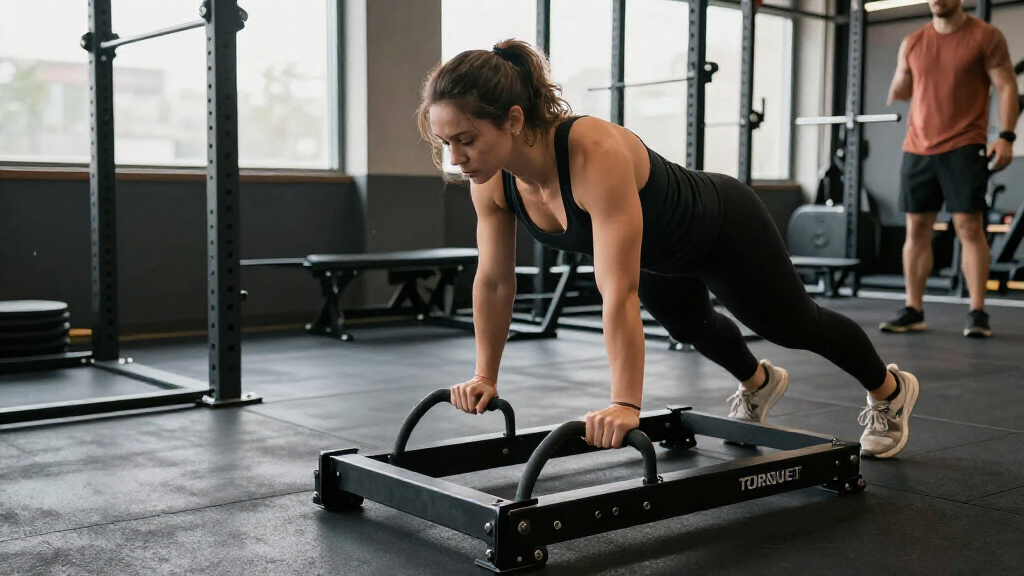
The TANK M1 is my best overall pick because it delivers a distinct strength-training tool without requiring a rack, rig, or wall installation. It is a manually operated sled with a Mag-Force variable-resistance brake, so it can support more than one kind of push or pull session rather than locking the buyer into a single fixed resistance setting. That flexibility helps explain why it leads this group: the other two products offer excellent, specialized movement patterns, but both are built around mounting to a structure.
For garage gyms and personal-training spaces, the removable handles are a practical feature, not a cosmetic one. They make the sled easier to store and transport than a permanently extended handle setup would be. Its reported quiet operation may also matter when training near other household members or in a shared gym. The alloy-steel frame and stated warranty coverage—10 years on the frame and welds, with one year on parts and workmanship or materials—give buyers useful ownership details to check against their expected use.
The main tradeoff is weight versus portability. At 67 pounds, the M1 is not a lightweight piece of kit to lift in and out of a vehicle or carry across a long distance. Its compact footprint can also be limiting if your training plan calls for a larger sled or a particular handle arrangement. Compared with the Relentless Ripper, it lacks a workout monitor and multiple numbered resistance levels; compared with the Rope Trainer, it asks for open travel space rather than a rack attachment. I’d choose it for adaptable sled work, not for tracking intervals or rope-specific training.
Pros:- Mag-Force brake provides variable resistance for different movements and effort levels.
- Quiet operation is suitable for shared or residential training spaces.
- Removable handles make storage and transport more manageable.
- Designed for use on a range of surfaces.
Cons:- At 67 pounds, it can be cumbersome to move between locations.
- Its compact design may not suit every training setup or preferred sled configuration.
Best for: Garage-gym owners, trainers, and outdoor exercisers who want a manual sled with variable resistance and no fixed rack or wall mount.
Not ideal for: Buyers who need a very light sled to carry frequently, have limited room to push it, or want built-in workout metrics and a fixed mounting setup.
- Item type:Push sled
- Operation:Manual
- Resistance:Mag-Force variable-resistance brake
- Weight:67 pounds
- Material:Alloy steel
- Handles:Removable
- Warranty:10 years on frame and welds; 1 year on parts and workmanship or materials
Our verdict“I recommend the TANK M1 to buyers who want the lineup’s most adaptable manual option and can accommodate its weight and travel space.”
Torque Fitness Relentless Ripper Ski Machine
If workout structure and feedback matter more than being able to move the equipment around, I’d choose the Relentless Ripper Ski Machine. Its 10 levels of progressive magnetic resistance offer finer selection than the Rope Trainer’s four settings, while the LED monitor tracks time, strokes per minute, watts, calories, and distance. Those readouts make it easier to define a session around measurable output instead of relying only on feel. That is the Ripper’s clear advantage over the TANK M1, which offers variable resistance but no listed monitor.
The mounting design helps conserve floor space, particularly in a home gym where a full freestanding machine would be difficult to place. Ergonomic grips support both single- and double-pole movements, giving users ways to vary their ski-style training. Its 50-pound weight and listed dimensions—24.5 by 21 by 39.1 inches—also help buyers plan the installation area. The product is described as compatible with racks, rigs, wall mounts, and uprights from other manufacturers, but the specific mounting surface still needs to meet the product’s compatibility requirements.
That mounting requirement is the reason this pick ranks behind the M1 for broad use. The Ripper needs both a suitable mounting point and corded electric power, so placement is less flexible than with a manual sled. It is also a more specialized training choice: buyers seeking sled pushes or rope pulls should not treat it as a substitute for the other two products. Against the Rope Trainer, the Ripper offers more resistance levels and more detailed monitoring, but that added structure comes with a power requirement and a more involved placement plan. The stated warranty covers 10 years on the frame, five on structural moving parts, and two on miscellaneous parts.
Pros:- Ten magnetic resistance levels allow more adjustment than the Rope Trainer’s four settings.
- Monitor displays time, strokes per minute, watts, calories, and distance.
- Rack, rig, and wall mounting can reduce the floor space needed for training.
- Ergonomic grips support single- and double-pole movements.
Cons:- Requires a compatible mounting surface, which restricts placement.
- Corded electric power may limit where it can be installed.
Best for: Home or gym users who have a compatible rack, rig, or wall mount and want adjustable ski-style resistance with session metrics.
Not ideal for: Buyers without a suitable mounting surface or nearby outlet, and anyone primarily looking for sled pushes or rope-training movements.
- Resistance:10 levels of progressive magnetic resistance
- Mounting:Compatible racks, rigs, wall mounts, and other manufacturer uprights
- Monitor:Time, strokes per minute, watts, calories, and distance
- Handle type:Ergonomic
- Power:Corded electric
- Weight:50 pounds
- Dimensions:24.5 × 21 × 39.1 inches (D × W × H)
- Warranty:10 years on frame; 5 years on structural moving parts; 2 years on miscellaneous parts
Our verdict“I’d pick the Relentless Ripper for measurable, adjustable ski-style sessions when a compatible mount and outlet are already available.”
Torque Fitness Relentless Rope Trainer
The Relentless Rope Trainer is the specialist in this lineup: choose it when your programming centers on rope pulls rather than general sled work or ski-style movement. Its magnetic resistance is bidirectional, and resistance rises as the user pulls faster or harder. That effort-responsive behavior makes the machine a different proposition from selecting a fixed load and completing reps at a steady pace. It has four resistance levels, giving users a way to set a broad baseline before changing their pace and force through the rope.
A pivoting head helps maintain proper rope wrap as the movement angle changes, supporting varied pulling directions. The three-strand twisted marine-grade rope is specified for the trainer, and the machine fits racks or rigs with uprights up to 6 by 6 inches. At 17 by 10 by 16 inches and 45 pounds, it is a compact mounted unit rather than a floor-based sled. Compared with the Ripper, it is more focused on rope handling and has fewer resistance settings; compared with the TANK M1, it occupies less open travel space but depends much more on installation compatibility.
The biggest buying hurdle is not the training idea but where and how it attaches. A compatible rack or rig is required, and a wall-mount bracket is sold separately. If your gym has no appropriate structure, the trainer cannot offer the same ready-to-position flexibility as the M1. It also lacks the Ripper’s listed performance monitor, so buyers who want tracked watts, distance, or timed output should look there instead. I rank it third not because its rope-resistance concept is less useful, but because it has a narrower training purpose and requires a compatible fixture before it can be used.
Pros:- Bi-directional magnetic resistance supports pulls in both directions.
- Resistance rises with pulling speed and effort, allowing self-paced intensity.
- Four resistance levels provide selectable starting settings.
- Pivoting head helps maintain rope wrap across different pulling angles.
Cons:- Requires a compatible rack or rig, or a separately sold wall-mount bracket.
- Four resistance levels provide less adjustment than the Ripper’s ten.
- No performance monitor is listed for tracking workout metrics.
Best for: Rack- or rig-equipped users who want bi-directional rope training with resistance that responds to pulling speed and effort.
Not ideal for: People without a compatible rack or rig who do not want to purchase a separate wall bracket, or buyers seeking ski-machine metrics or open-space sled work.
- Resistance type:Magnetic
- Resistance levels:4
- Movement:Bi-directional
- Mount compatibility:Racks or rigs with tubing up to 6 × 6 inches
- Rope:Three-strand twisted marine-grade rope
- Weight:45 pounds
- Dimensions:17 × 10 × 16 inches (D × W × H)
- Mounting note:Wall-mount bracket sold separately
Our verdict“I recommend the Rope Trainer for buyers with a compatible rack who specifically want responsive, bidirectional rope work rather than a general-purpose conditioning tool.”
How We Picked
I ranked these products by the practical questions that shape a Torque Fitness strength-equipment purchase: what movements each supports, what a home or commercial setup must provide, how clearly resistance can be adjusted, and how much useful training feedback comes with the machine. I did not treat these as three versions of the same product. A push sled, a rope trainer, and a ski machine serve different goals, so the ranking reflects versatility and setup flexibility rather than a claim that one movement is universally better.
The TANK M1 takes the top position because it is the least dependent on a dedicated fixture. Its manual operation and removable handles suit varied sessions and easier storage, while its quiet variable-resistance brake adds flexibility beyond a fixed-load sled. Its limitations matter: it weighs 67 pounds, and buyers still need a usable training surface and enough room to move it.
I place the Relentless Ripper second because it brings the most structured resistance selection and workout tracking. Ten magnetic resistance levels and a monitor make it the strongest fit for people who want to adjust effort and follow metrics. It ranks below the M1 for general setup flexibility because it needs a compatible mount and a power outlet. The Relentless Rope Trainer rounds out the list as a capable, focused option for rope training. Four magnetic settings, bi-directional movement, and effort-responsive resistance are useful, but rack compatibility or an additional wall bracket narrows its fit. I have based these judgments on the supplied product specifications and descriptions, not on personal testing.
Factors to Consider When Choosing Best Torque Fitness Strength Equipment
I’d choose among these Torque Fitness options by working backward from the space and movement pattern I can support. The equipment differs enough that a preferred exercise should lead the decision: sled pushes point to the M1, ski-style pole work to the Ripper, and rope pulls to the Relentless Rope Trainer. Once that is clear, compare installation needs, resistance controls, and the kind of feedback you want from a session.
Start with the movement you want to train
Movement pattern matters more than the product name. The TANK M1 is a push sled for manually driven work and can support different movements using its variable-resistance brake. The Ripper is purpose-built for ski-style pulling with single- or double-pole grips. The Rope Trainer centers on bi-directional rope movement, with effort and pulling speed influencing resistance. These are not interchangeable stations, even though all three can contribute to strength and conditioning.
If you want one piece for a broad garage-gym plan, the M1 has the widest practical appeal in this group because it is not tied to one mounting structure. If your training plan already includes ski-erg-style intervals, the Ripper’s movement and monitor are the more direct fit. Rope intervals and varied-angle pulls make the Rope Trainer the clear specialist. I would avoid choosing only by the most impressive-looking feature: a monitor is of limited value if you will not use ski-style movements, and a rope trainer is a poor match if your space has no compatible attachment point.
Check your space and mounting options before buying
The M1 needs room to travel across a suitable training surface, but it does not require the rack or wall attachment needed by the Relentless machines. That makes it a stronger fit for outdoor sessions or a garage with open floor space. Its removable handles help with storage, though the 67-pound weight still makes frequent carrying a real consideration. Plan where it will live between sessions and how it will reach the training area.
The Ripper and Rope Trainer save floor space by mounting to a structure, but that convenience depends on compatibility. The Rope Trainer specifies racks or rigs with uprights no larger than 6 by 6 inches; its wall bracket is sold separately. The Ripper lists compatibility with racks, rigs, wall mounts, and other manufacturers’ uprights, but buyers still need to confirm that their intended mounting setup is suitable. The Ripper also uses corded electric power, so placement needs to account for an outlet. I’d verify the mount and power arrangement before treating either machine as a space-saving solution.
Compare resistance control and workout feedback
The three products give you different kinds of control. The TANK M1 uses variable resistance through its Mag-Force brake, which suits changing movements and effort without a listed set of numbered levels. The Rope Trainer has four selectable magnetic resistance levels, then adds a responsive element: resistance increases as you pull harder or faster. The Ripper has ten progressive magnetic resistance levels, giving buyers the most explicit range of preset choices in this comparison.
Only the Ripper lists a performance monitor. It tracks time, strokes per minute, watts, calories, and distance, making it the natural fit for users who plan sessions around measurable output. The Rope Trainer’s effort-responsive feel may be enough for users who want to work by pace and exertion, while the M1 is the option for sled sessions without a listed display. I would not treat more settings or metrics as automatically better; they matter when they match the way you plan and review workouts.
Match the equipment to your training experience and routine
For a newer strength trainee, the M1 can be the most straightforward place to start if sled movements already fit the plan and the training area can accommodate them. Its variable resistance offers a way to vary effort, but buyers should learn how to use the sled safely and select an appropriate surface. The Ripper may appeal to users who value defined resistance levels and a monitor for following repeat sessions. The Rope Trainer is better suited to someone with a clear interest in rope work and a rack-based gym routine.
Think about who will share the equipment, too. The M1’s quiet operation and removable handles may help in a multi-use home space. The Ripper’s metric display can support repeatable individual sessions, but it needs power and a permanent mounting plan. The Rope Trainer may fit neatly into an existing rack setup, yet becomes less convenient if the rack is already crowded or incompatible. Choose the machine that fits the routine you expect to repeat, rather than adding a specialized movement you do not currently plan to use.
Read the ownership details alongside the headline features
Warranty coverage and materials can help clarify what each product is built to support, but they do not remove the need to check fit and care requirements. The M1 specifies an alloy-steel frame and a 10-year warranty on frame and welds, with one year on parts and workmanship or materials. The Ripper lists 10 years on the frame, five years on structural moving parts, and two years on miscellaneous parts. The Rope Trainer’s supplied specifications do not include warranty details, so I would confirm current coverage with the seller before purchase.
Also think through the ongoing setup: the M1 needs a suitable surface and enough travel room; the mounted products need a structure that can accept the unit, and the Ripper needs corded power. These practical requirements can matter more day to day than a small difference in resistance settings. My final check would be to measure the space, verify attachments and power, and decide whether the planned workout is sled-based, ski-style, or rope-focused.
Frequently Asked Questions
Which Torque Fitness product is the most versatile of these three?
I’d give that role to the TANK M1 Push Sled because it is not dependent on a rack, rig, or wall mount and uses a variable-resistance brake. It can suit different sled movements on appropriate surfaces. Its versatility has limits, though: it needs room to travel, weighs 67 pounds, and does not list a workout monitor. The Ripper and Rope Trainer are more specialized, but can be better choices when ski-style or rope work is the clear priority.
Do the Relentless Ripper and Rope Trainer need a rack?
Both are designed to attach to a suitable structure, but their listed arrangements differ. The Rope Trainer fits racks or rigs with uprights up to 6 by 6 inches, while a wall-mount bracket is sold separately. The Ripper is described as compatible with racks, rigs, wall mounts, and other manufacturers’ uprights. I’d confirm the dimensions and installation requirements for the exact mounting location before choosing either one; the Ripper also needs corded electric power.
Which machine is best if I want to track workout results?
The Relentless Ripper Ski Machine is the clear choice for built-in tracking. Its monitor lists time, strokes per minute, watts, calories, and distance. Neither the TANK M1 nor the Rope Trainer lists a comparable performance monitor in the supplied specifications. If you prefer to manage training by effort, the Rope Trainer’s resistance increases with pulling speed and force, while the M1 offers variable resistance for sled work.
Can I use the TANK M1 outdoors?
The M1 is described as suitable for a range of surfaces and for outdoor workouts, which makes it the most adaptable of these three for that setting. The surface still needs to be appropriate for sled use, and the 67-pound weight can make transport awkward. The two Relentless machines are mounting-based products, so they are less suited to being moved outside for a session unless a compatible mounting setup is available there.
How should I choose between the Ripper and the Rope Trainer?
Choose the Ripper if you want ski-style movement, ten magnetic resistance levels, and a monitor with several workout metrics. Pick the Rope Trainer if your focus is bi-directional rope pulling and you want resistance to respond to how fast and hard you pull. The Ripper offers more preset levels and data, but it requires corded power as well as a compatible mount. The Rope Trainer avoids that listed power requirement, but it has four levels and needs a compatible rack or a separately purchased wall bracket.
Conclusion
My recommendation depends on the training space and movement you want most. For the broadest use without a fixed installation, I’d choose the TANK M1 Push Sled, provided I had room to move a 67-pound sled and a suitable surface. For a rack- or wall-mounted station with measurable ski-style workouts, I’d choose the Relentless Ripper—especially if its monitor and ten resistance levels would shape the routine. For a gym already built around a compatible rack and rope intervals, the Relentless Rope Trainer is the focused pick. Confirm space, mounting, and power requirements before deciding: those details separate an appealing feature list from equipment that fits the way you actually train.