
TL;DR

Get workout gear delivered free with Prime
- Fast, free delivery on millions of items
- Prime Video, Amazon Music and more included
- Member-only deals all year
Researchers reported that a sphingolipid measured in exhaled breath condensate distinguished idiopathic pulmonary fibrosis from fibrotic hypersensitivity pneumonitis in a study presented at the CHEST meeting. The result is promising but preliminary: few participants provided breath samples, and independent validation and practical testing standards are still needed.
Researchers reported that a lipid measured in exhaled breath condensate could help distinguish idiopathic pulmonary fibrosis (IPF) from fibrotic hypersensitivity pneumonitis, two lung diseases that can be difficult to tell apart. In the study presented at the CHEST meeting in Phoenix, sphingomyelin C24:0 correctly predicted fibrotic hypersensitivity pneumonitis in 80% of cases and IPF in 85.7%; the findings have not yet been externally validated.
The breath-test result had an area under the receiver operating characteristic curve (AUC) of 0.897, a measure of how well a test distinguishes between groups. The study also examined plasma dihydrosphingosine, a blood marker, which had a lower standalone AUC of 0.737. Combining the blood and breath measures yielded an AUC of 0.906, a small difference from the breath measure alone, according to the researchers.
The study included 101 people who provided blood samples: 28 healthy controls, 33 people with IPF and 40 with fibrotic hypersensitivity pneumonitis. Breath condensate was available from a smaller subset: 10 controls, 21 IPF patients and 18 patients with fibrotic hypersensitivity pneumonitis. The smaller breath-sample group is relevant when interpreting the reported performance.
Jon Mullholand, MD, of Virginia Commonwealth University, presented the findings at the meeting hosted by the American College of Chest Physicians. The report describes the results as research findings, not an available or established clinical diagnostic test. Mullholand said sphingolipid tests are not commonly available as assays, and many U.S. laboratories do not accept exhaled breath condensate for analysis.
A Potential Aid in Lung Diagnosis
Distinguishing IPF from fibrotic hypersensitivity pneumonitis can affect treatment decisions and expectations about disease course. The conditions may share clinical, imaging and pathological features, particularly in advanced disease. A mistaken diagnosis can lead to a treatment approach that does not fit the patient’s condition, Mullholand said, with possible consequences for outcomes.
A breath-based measure could offer a noninvasive way to add diagnostic information if further studies confirm the results. Unlike a blood sample, which can reflect changes throughout the body, breath condensate may capture features of the local lung environment. That makes the approach scientifically interesting, but the reported accuracy does not establish that it can replace current diagnostic assessment or improve patient outcomes.
As an affiliate, we earn on qualifying purchases.
Why Breath Samples Were Studied
Sphingolipids are a group of lipids involved in processes including inflammation and fibrosis. Earlier research had found altered sphingolipids in IPF. In this study, the team compared these molecules in blood and in exhaled breath condensate from people with the two fibrotic conditions, as well as healthy controls.
Mullholand said breath condensate may offer a closer view of activity in the lungs. The study found different patterns across the sample types: blood showed more changes among people with IPF, while breath condensate showed stronger increases among those with fibrotic hypersensitivity pneumonitis. These observations may help guide future research, but the study does not establish why the patterns occur or whether they directly reflect disease mechanisms.
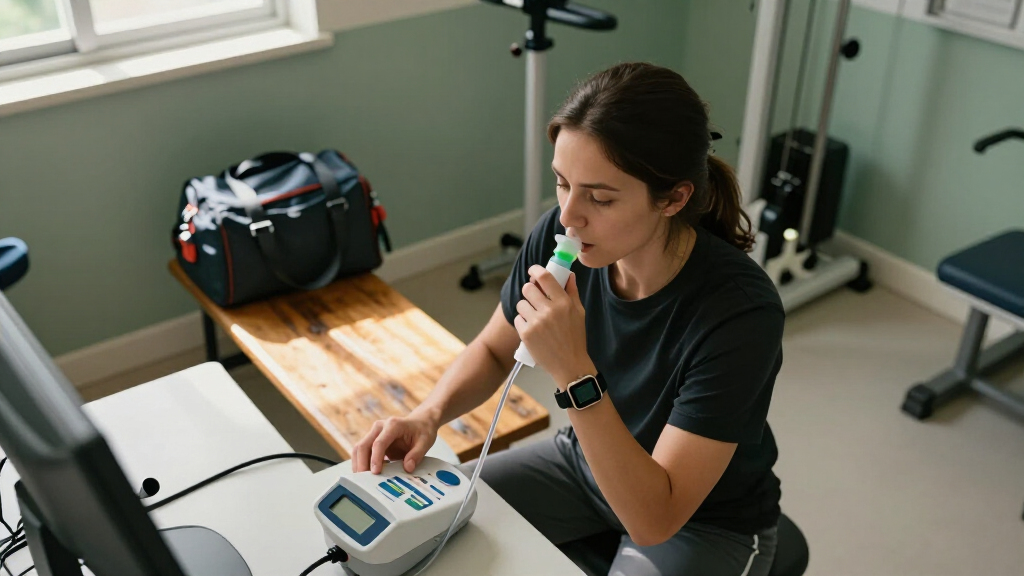
Breath condensate is collected by having a patient breathe through a tube-like device. A refrigerant cools the breath so a liquid sample can be collected for testing. The process can take 15 to 20 minutes, and Mullholand said it may be difficult for people with substantial breathing impairment. Practical collection and laboratory methods have also limited wider use of the approach.
“There’s a diagnostic challenge when we’re trying to differentiate these [two conditions] at end-stage disease, as they can have overlapping clinical presentations as well as imaging features, even pathologic slides.”
— Jon Mullholand, MD, of Virginia Commonwealth University, speaking at the CHEST meeting
As an affiliate, we earn on qualifying purchases.
Validation and Testing Questions
The findings come from a study presented at a medical meeting, and the breath-test performance was calculated from only 49 participants who supplied condensate samples. The source report does not provide details about an independent validation cohort, confidence intervals, or how the test would perform across a broader range of patients and clinical settings. The researchers said external validation is needed.
It is also unclear whether the reported accuracy would hold when the test is used alongside the diagnostic methods clinicians already rely on. The study does not establish that the test changes treatment decisions, improves outcomes, or can distinguish these diseases in every patient. The availability of standardized collection, processing and laboratory analysis remains another open issue.
Researchers also have not established whether the lipid pattern is part of the biological pathway driving disease or a consequence of it. Those questions, as well as the time and effort required to collect samples from people with severe lung disease, need further study before routine use can be judged.
As an affiliate, we earn on qualifying purchases.
Independent Studies and Clinical Use
The next stated step is external validation of the breath-test findings in a separate group of patients. Such research would need to assess whether the test’s performance is reproducible and how it compares with existing diagnostic approaches. Work on reliable sample collection and analysis would also be needed before laboratories could offer the test consistently.
Mullholand said the lipid findings could also prompt research into whether sphingolipids point to a mechanism involved in fibrosis. No timeline for validation, regulatory review or clinical availability was given in the source report. For now, the results should be treated as preliminary research rather than a recommendation for patients to seek or use a breath test.
As an affiliate, we earn on qualifying purchases.
Key Questions
What did the breath test measure?
The researchers measured sphingomyelin C24:0 in exhaled breath condensate, a liquid collected by cooling a person’s breath.
How well did it distinguish the two conditions?
In the study, the marker correctly predicted fibrotic hypersensitivity pneumonitis in 80% of cases and IPF in 85.7%. These are study results, not a guarantee of accuracy for individual patients or other populations.
Can patients get this test now?
The report says the test is not in routine clinical use. Sphingolipid assays are not commonly available, and many laboratories do not accept breath condensate for analysis.
What needs to happen before the test could be used in clinics?
The results need to be checked in an independent validation study, and researchers must address reproducibility, sample collection and laboratory testing. The report gives no timeline for clinical availability.
Source: rss
Fall Picks
fall essentials
As an affiliate, we earn on qualifying purchases.