

If you’re choosing between double progression and linear progression, consider your goals and experience level. Linear progression moves weights up steadily with consistent reps, making it simple and ideal for beginners. Double progression adjusts both reps and weight, providing more variation and better for avoiding plateaus. Both methods require discipline, but your specific needs will determine the best fit. Keep exploring to discover how to optimize either scheme for your strength gains.
Key Takeaways
- Linear progression involves steady, predictable increases in weight, ideal for beginners or those seeking simplicity.
- Double progression adjusts reps and weight, offering greater flexibility and suitability for intermediate lifters.
- Linear progression emphasizes consistent load increases with minimal variation, reducing overtraining risks.
- Double progression incorporates variation by increasing reps first, then weight, helping avoid plateaus.
- Choice depends on training experience, goals, and preference for routine predictability versus flexibility.
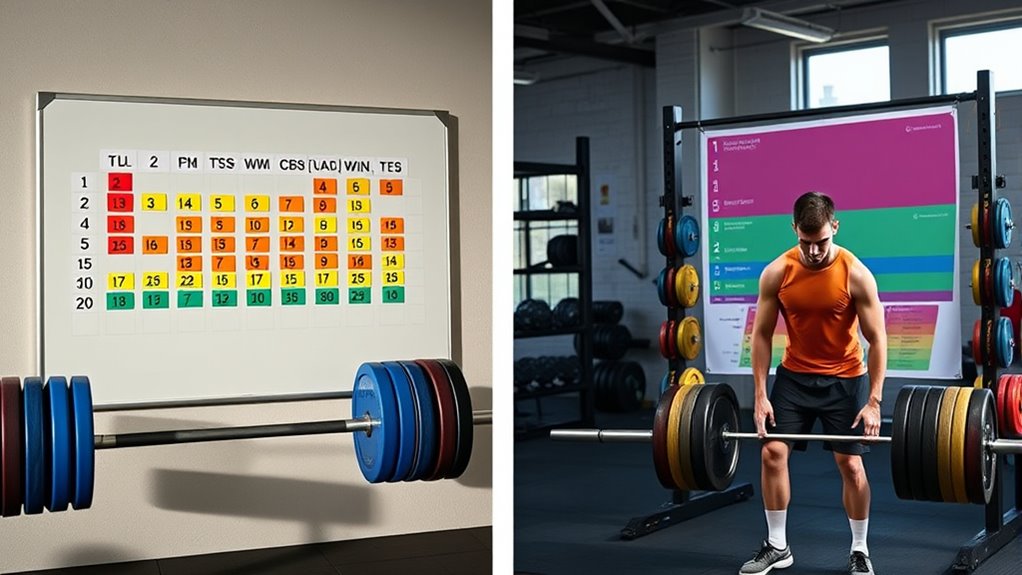
Strength progression schemes are essential tools for anyone looking to build muscle and increase overall strength effectively. They help you structure your training to ensure consistent progress while minimizing plateaus. Two popular methods are double progression and linear progression, each with its own approach to managing workout variation and periodization planning. Understanding how these schemes work can help you choose the best fit for your goals and training style.
Linear progression is straightforward and easy to follow. You increase the weight you lift in small, consistent steps over time. For example, if you’re doing squats, you add a little more weight each session or week as long as you can complete your target reps with good form. This approach relies on steady, predictable increases, making it ideal for beginners or those who prefer simplicity. Because the focus is on gradually increasing load, workout variation is minimal—you’re mainly increasing weight while keeping reps and sets consistent. This simplicity allows your body to adapt steadily, reducing the risk of overtraining and promoting strength gains. Additionally, maintaining proper training volume is crucial to ensure effective progress without overexertion.
Linear progression involves small, steady increases in weight over time for consistent strength gains.
Double progression, on the other hand, adds more nuance to periodization planning by involving two variables: reps and weight. You start by performing a set number of reps at a certain weight. Once you can complete the upper limit of reps comfortably, you increase the weight in small increments. Then, if you find yourself struggling to hit the target reps, you focus on increasing reps first before adding more weight. This method offers more workout variation because you’re adjusting both reps and load within the same training cycle. It keeps your muscles constantly challenged, reducing the chance of hitting plateaus. Double progression is especially effective for intermediate lifters who want to optimize gains without risking burnout, as it allows for more flexibility and fine-tuning within your programming.
Both schemes require good periodization planning, but they approach progression differently. Linear progression emphasizes consistency and simplicity, making it easier to follow and track. Double progression offers more adaptability, which can lead to more sustainable growth over time. If you prefer a straightforward, predictable routine, linear progression might suit you best. If you’re comfortable with a more nuanced approach that incorporates workout variation, double progression can help you push past sticking points and avoid plateaus. Whichever you choose, the key is to stay disciplined and listen to your body, ensuring that your training remains safe, effective, and aligned with your strength goals.

TYZDMY Adjustable Dumbbells Set of 2,Free Weights Dumbbells Set,Adjustable Dumbbell Set,52.5 lbs pair 105 lbs,15 in 1,for Men/Women Gym Equipment for Home Strength Training Equipment
【15 in1 Adjustable Dumbbells】You will receive a pair of 52.5 lb dumbbells, each adjustable in 15 different weights:…
As an affiliate, we earn on qualifying purchases.
As an affiliate, we earn on qualifying purchases.
Frequently Asked Questions
Which Progression Scheme Is Better for Beginners?
For beginners, linear progression is usually better because it encourages progression consistency and is easier to follow. You can focus on gradually increasing weight each session, which helps adapt quickly and builds confidence. Double progression might be effective later, but initially, sticking to a simple, linear scheme allows you to see steady gains and stay motivated without overcomplicating your training.
How Do I Know When to Switch Schemes?
Like a knight seeking new quests, you should switch schemes when your progression stalls or feels too easy. Track your progression timing—if you’re consistently hitting the upper limits of your current scheme without improvement, it’s time to adapt. Switch schemes when you notice that your current one no longer challenges you, ensuring continuous gains. Listening to your body and tracking progress helps you decide the perfect moment for scheme adaptation.
Can I Combine Double and Linear Progressions?
Yes, you can combine double and linear progressions to enhance your training. This approach allows for scheme customization, helping you maintain progression consistency. For example, use linear progression for steady weight increases and switch to double progression when you hit a plateau. Mixing schemes keeps your workouts fresh, challenges your muscles differently, and guarantees steady strength gains. Just listen to your body and adjust as needed for ideal results.
What Are the Common Mistakes in Each Scheme?
Think of your progress as a garden that needs careful tending. Common mistakes include neglecting progression consistency, which stunts growth, and sticking rigidly to one scheme without customization. For double progression, rushing increases can cause burnout, while in linear, skipping steps hampers steady gains. You must adapt schemes to your needs, ensuring consistent progression and flexibility to avoid plateaus and injuries.
How Do Progression Schemes Vary Across Different Lifts?
You’ll notice that progression schemes vary across different lifts by incorporating periodization strategies and intensity cycling. For compound lifts like squats and deadlifts, you might use linear progression to steadily increase weight, while accessory lifts benefit from double progression to adjust volume and intensity. Tailoring your approach guarantees continuous strength gains, preventing plateaus and overtraining. Always listen to your body and adjust your scheme accordingly for ideal results.
Weight Lifting Log Book: Workout And Fitness Progress, Measurements, Exercises, Cardio, Goals Record Tracker for Men and Women – 108 Pages, 6"x9"
As an affiliate, we earn on qualifying purchases.
As an affiliate, we earn on qualifying purchases.
Conclusion
In the end, choosing between double and linear progression shapes your strength journey. Double progression offers the flexibility to crush your limits, pushing you beyond what you thought possible. Linear progression keeps you steady, building solid foundations step by step. Remember, your progress isn’t just a number—it’s a proof to your dedication. Pick the scheme that fuels your fire, and watch your strength soar higher than you ever dreamed, transforming your workouts into legendary feats.

WHATAFIT Resistance Bands, Exercise Bands,Resistance Bands for Working Out, Work Out Bands with Handles for Men and Women Fitness, Strength Training Home Gym Equipment
DIFFERENT COLOR ADJUSTABLE RESISTANCE BANDS: The exercise bands come with 5 different resistance level 10lbs, 20lbs, 30lbs, 40lbs…
As an affiliate, we earn on qualifying purchases.
As an affiliate, we earn on qualifying purchases.

Weight Lifting Log Book: Workout and Fitness Record Tracker for Men and Women
As an affiliate, we earn on qualifying purchases.
As an affiliate, we earn on qualifying purchases.