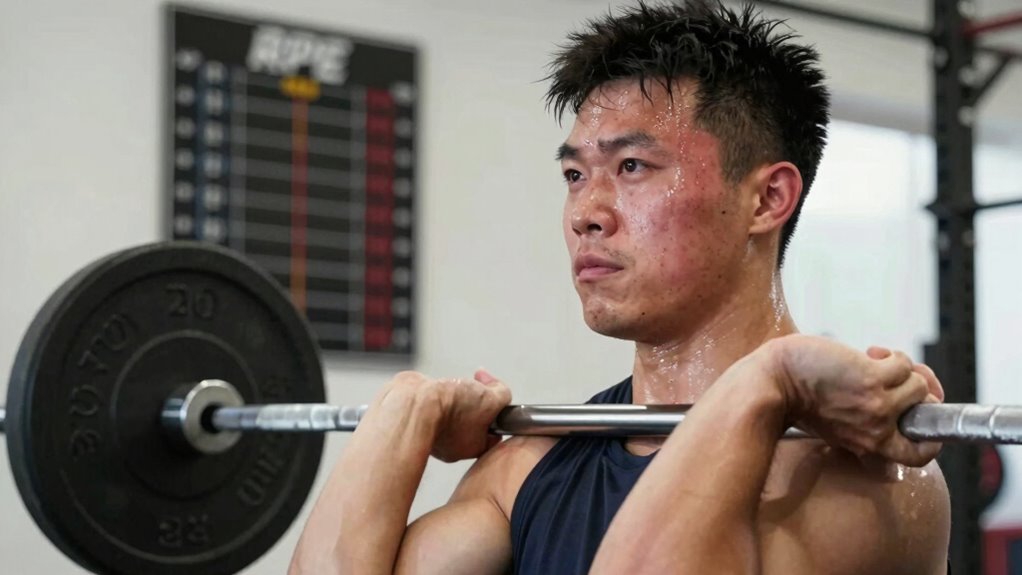

To train effectively with the RPE scale, learn to listen to your body’s signals like breathing, muscle fatigue, and heart rate. Use the scale from 6 to 20 to gauge effort, adjusting your workout based on how hard it feels rather than just numbers. Staying consistent with your perceived effort helps prevent overtraining and boosts results. If you’d like to master how to fine-tune your workouts by feel, you’ll find helpful tips below.
Key Takeaways
- Use the 6-20 RPE scale to gauge effort based on your body’s signals during exercise.
- Develop mental benchmarks for each RPE level by monitoring breathing, muscle fatigue, and heart rate.
- Maintain consistent effort ratings across sessions to accurately track progress and prevent overtraining.
- Adjust workout intensity based on RPE feedback—increase if easier than expected, decrease if too strenuous.
- Regularly review your effort ratings to refine your understanding of effort, optimize training, and achieve better results.

Sweetzer & Orange Fitness Planner Notebook – 6" x 8.5" Workout Log Book & Fitness Journal – 129 Pages with Measurement Tracker, Weight Tracker, Workout Planner, Food Log, 30 Day Challenge & Notes – Gold Spiral
Structured For Real Progress – This fitness planner notebook brings your entire routine into one place, with dedicated…
As an affiliate, we earn on qualifying purchases.
As an affiliate, we earn on qualifying purchases.
Understanding the RPE Scale and Its Origins
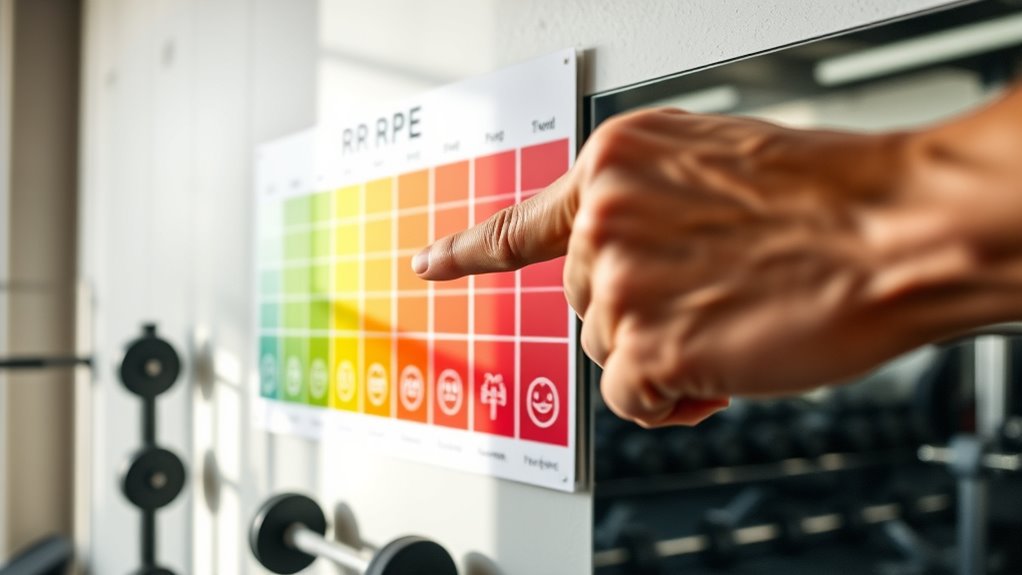
The RPE (Rate of Perceived Exertion) scale helps you gauge how hard you’re working during exercise, but understanding its origins gives you insight into its effectiveness. The scale was developed in the 1960s by Swedish psychologist Gunnar Borg to measure how hard exercise feels to you. It’s based on the idea that your perception of effort correlates with physiological responses like heart rate and breathing. Borg’s research showed that people could reliably rate their exertion on a simple scale, typically from 6 to 20, which corresponds to different effort levels. This subjective method allows you to assess intensity without needing specialized equipment. Recognizing its origin highlights how it leverages your body’s natural signals to help you train smarter and more intuitively. Additionally, understanding how body responses relate to perceived effort can improve your training accuracy.

LIVIKEY Fitness Tracker Watch with Heart Rate Monitor, Activity Tracker with Pedometer, Sleep Monitor, Calories & Step Counter, IP68 Waterproof Smart Watches for Women Men Fitness Watch for Sports
Heart Rate and Sleep Monitoring: The Fitness Tracker monitors your heart rate automatically all day, and you can…
As an affiliate, we earn on qualifying purchases.
As an affiliate, we earn on qualifying purchases.
How to Accurately Assess Your Effort During Exercise

To accurately assess your effort, start by paying close attention to your physical cues, like breathing rate and muscle fatigue. Consistently use the same RPE scale to track how hard you feel you’re working, which helps improve your judgment over time. This approach guarantees you can adjust your intensity for maximum training results. Recognizing your perceived exertion can help you make more informed decisions during your workouts. Additionally, understanding how contrast ratio affects visual clarity can help you better gauge the intensity of your effort through visual cues.
Recognize Physical Cues
Recognizing physical cues during exercise is essential for accurately evaluating how hard you’re working. Pay attention to your breathing—if you’re gasping or breathing rapidly, you’re likely pushing too hard. Notice your muscle feelings: a burning sensation can indicate high effort, while mild fatigue suggests a moderate pace. Be aware of your heart rate; a pounding heartbeat often signals increased effort. Also, observe your body’s overall signals, like sweating, skin temperature, and muscle tension. If you feel lightheaded or overly exhausted, you’re probably overexerting. Incorporating biofeedback techniques can further enhance your ability to accurately assess your effort levels and optimize training outcomes. Developing an understanding of perceived exertion helps you fine-tune your effort without relying solely on external tools. Additionally, paying attention to internal cues can improve your awareness of your body’s responses during exercise.
Use Consistent RPE Scale
Using a consistent RPE (Rate of Perceived Exertion) scale helps you accurately judge how hard you’re working during exercise. When you stick to the same scale each time, it becomes easier to compare your efforts from session to session. This consistency sharpens your awareness of what different effort levels feel like, preventing confusion or misjudgment. Make sure you understand what each point on the scale represents and apply it uniformly. For example, if you rate a workout as a 7 today, aim to rate similar efforts the same way in future sessions. This uniformity improves your ability to tailor workouts, track progress, and avoid overtraining or undertraining. Ultimately, it makes your training more precise and effective.

congumi 5 in 1 Stainless Steel Gua Sha Muscle Scraper Tools Set, Scraping Tools Kit for Physical Therapy, IASTM Tools, Guasha Tools for Deep Tissue Massage with Storage Bag
【Medical-Grade Stainless Steel】This 5-piece Gua Sha tool set is crafted from medical-grade stainless steel, offering outstanding durability and…
As an affiliate, we earn on qualifying purchases.
As an affiliate, we earn on qualifying purchases.
Different RPE Levels and What They Mean for Your Workout

Understanding the different RPE levels can help you gauge how hard your workout feels and adjust accordingly. RPE scales typically range from 1 to 10, with each number representing a specific effort level. For example, an RPE of 3 means you’re exerting minimal effort—maybe just warming up. An RPE of 5 or 6 indicates a moderate effort where you can speak comfortably. RPE 8 to 9 signifies a hard effort, where talking becomes difficult, but you’re still able to push through. An RPE of 10 is maximum effort—completely exhausting and unsustainable for long. Recognizing these levels helps you target the right intensity for your goals, whether you’re building endurance, strength, or recovery, ensuring your workout is effective without overtraining.

Rate of Perceived Exertion (RPE) Chart – Exercise Intensity Guide Poster, Minimalist Fitness Wall Art for Workout Room Decor(Unframed,08x12inch(20x30cm))
We have reserved a 0.6in (1.5cm) white margin for you, which is convenient for you to frame with…
As an affiliate, we earn on qualifying purchases.
As an affiliate, we earn on qualifying purchases.
Benefits of Training by Feel vs. Relying on Strict Metrics

Training by feel allows you to listen to your body and adjust intensity in real-time, which can lead to more sustainable and enjoyable workouts. When you rely on sensations like effort and fatigue, you develop a deeper understanding of your body’s signals, making your training more personalized. This approach reduces the risk of overtraining or undertraining, ensuring consistent progress. Additionally, listening to your body helps foster a healthier relationship with exercise by emphasizing internal cues over external metrics. Being attentive to bodily sensations can also help prevent injury and promote recovery. Incorporating principles from Free Floating movement and awareness can further enhance your ability to gauge effort intuitively, encouraging a more mindful and body-aware training routine.
Practical Tips for Incorporating RPE Into Your Routine
Incorporating RPE (Rating of Perceived Exertion) into your routine can enhance your ability to gauge effort accurately without relying solely on metrics. Start by paying close attention to how different exercises feel during your workouts. Before each session, set a clear intention for the intensity you want to achieve. As you exercise, regularly check in with yourself—ask how hard the effort feels on a scale of 1 to 10. Keep a workout journal or log to track your perceived exertion and note any patterns. Use RPE to adjust your effort in real-time, especially if you’re feeling more tired or energized than usual. Over time, this practice will sharpen your intuition, making your training more intuitive, efficient, and effective.
Common Mistakes to Avoid When Using the RPE Scale
One common mistake is ignoring the proper RPE range, which can lead to overtraining or undertraining. Relying solely on how you feel without paying attention to consistency also skews your progress. To get the most out of the scale, avoid these pitfalls and stick to a steady, accurate assessment. Additionally, neglecting to incorporate training intensity can hinder your ability to gauge your training intensity effectively. Understanding power measurement can help you better calibrate your effort levels and optimize results. Recognizing the importance of exercise selection ensures your workouts target the right muscles and energy systems for balanced development.
Ignoring Proper Range
Many people make the mistake of ignoring the proper range when using the RPE scale, which can undermine their progress and increase the risk of injury. If you don’t train within your target RPE range, you might overtrain, undertrain, or miss the benefits of peak effort. This misalignment can lead to stagnation or burnout. To avoid this, pay close attention to your perceived exertion and adjust accordingly. Remember that:
- Training too low on the scale won’t stimulate progress.
- Going too high can cause overexertion and injury.
- Consistently missing the target range hampers adaptation.
- Proper range ensures balanced workload and recovery.
- Understanding your perceived exertion can help optimize training effectiveness.
- Being aware of training intensity helps prevent common pitfalls and promotes consistent improvement. Incorporating regular feedback about your effort level can further refine your training approach. Sticking within your ideal RPE range helps you make consistent gains without risking burnout or injury.
Relying on Feel Alone
Relying solely on how you feel during a workout can lead to inconsistent and unreliable results. Your perception of effort varies based on fatigue, mood, or even the time of day, making it hard to gauge true intensity. If you only go by feel, you might push too hard on some days and not enough on others, undermining your progress. This approach can also cause you to skip challenging sets or overexert yourself, risking injury or burnout. Instead, combine your feelings with objective cues, like RPE ratings, to stay consistent. Use your perception as a guide, but always check in with the scale to ensure you’re training at the right intensity. This balance helps you make steady progress and avoid the pitfalls of subjective judgment. Incorporating an understanding of the importance of perceptual awareness can enhance your ability to train effectively by aligning subjective feelings with actual effort levels.
Forgetting Consistency
To use the RPE scale effectively, you need to stay consistent in how you rate your effort across workouts. Inconsistent assessments can lead to unreliable progress and misjudged intensity. To avoid this, keep these points in mind:
- Develop a clear mental benchmark for each RPE level and stick to it.
- Track your ratings after every session to identify patterns.
- Avoid changing your perception of effort based on external factors like fatigue or motivation.
- Review your ratings periodically to make certain you’re applying the scale uniformly.
Adjusting Your Training Based on RPE Feedback
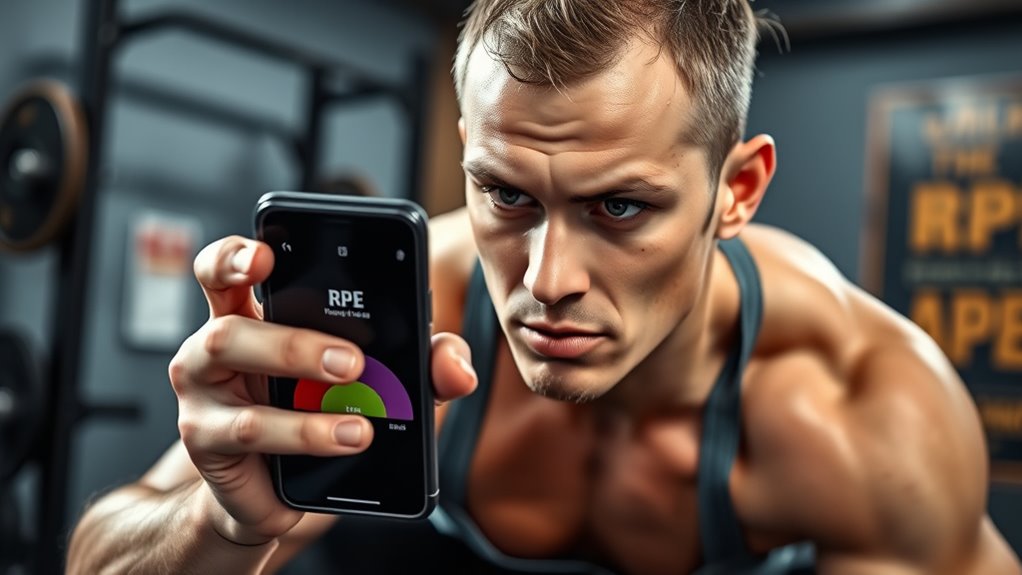
Adjusting your training based on RPE feedback allows you to fine-tune intensity levels and prevent overtraining. When you listen to how hard an exercise feels, you can modify your effort to stay within your desired training zone. If a session feels easier than expected, you might increase the weight or reps to challenge yourself appropriately. Conversely, if it feels too strenuous, you can reduce intensity to avoid burnout or injury. Regularly evaluating your RPE helps you identify patterns and adjust your plan accordingly. This ongoing feedback loop ensures you’re training smart, not just hard. Incorporating proper training equipment and techniques into your routine can further enhance your progress. Over time, you’ll develop a better understanding of your body’s signals, making your workouts more effective and sustainable. Developing an awareness of your perceived exertion is essential for creating a personalized approach that keeps you progressing without risking fatigue or setbacks. Paying attention to your training response can also help you recognize when to push harder or back off, leading to more consistent improvements. Additionally, understanding the importance of individual variability allows you to tailor your training to your specific needs.
Real-Life Examples of RPE-Driven Training Success

Have you ever wondered how athletes and everyday fitness enthusiasts achieve remarkable progress by listening to their bodies? RPE-driven training has helped many reach their goals effectively. For example, a marathon runner adjusts intensity based on how they feel, avoiding burnout and overtraining. A powerlifter uses RPE to gauge effort, allowing for ideal strength gains without risking injury. A busy professional incorporates RPE to balance training with a hectic schedule, ensuring consistency. Additionally, a recreational cyclist tailors rides in real-time, improving stamina sustainably. Using training techniques that incorporate RPE allows for better monitoring of effort and progress. Implementing training environment considerations, such as proper ventilation and temperature regulation, can further optimize training effectiveness and safety.
Listening to your body with RPE boosts progress and prevents injury for athletes and enthusiasts alike.
- Prevents overtraining and injury
- Enhances recovery and consistency
- Promotes personalized progress
- Builds intuitive training habits
Frequently Asked Questions
Can RPE Scale Be Used Effectively for Beginner Athletes?
Yes, you can effectively use the RPE scale as a beginner. It helps you listen to your body and gauge effort without obsessing over exact numbers. By focusing on how you feel during workouts, you learn to adjust intensity safely and build confidence. Start with simple ratings, like 5 or 6 for moderate effort, and gradually increase as you become more attuned to your body’s responses.
How Does Mental Fatigue Affect RPE Assessments?
Oh, the joys of mental fatigue—your brain’s way of turning a simple workout into a mind-bending puzzle. When you’re exhausted mentally, your RPE assessments become wildly unreliable, making every set feel like climbing Everest. You might overestimate effort, thinking you’re lifting a house, or underestimate and push too hard, risking injury. So, pay attention to how fresh your mind feels; it’s vital for honest, effective RPE evaluations.
Is RPE Suitable for All Types of Exercise?
Yes, RPE works for most exercise types, including cardio, strength, and flexibility workouts. You can gauge effort based on how hard you feel you’re working, making it adaptable across activities. However, it might be less precise for very technical sports or complex movements, where external cues or specific metrics could be more helpful. Overall, RPE encourages listening to your body and adjusting intensity accordingly for effective training.
How Often Should I Reassess My RPE During Training?
You should reevaluate your RPE during training every 10 to 15 minutes or after each set to guarantee you’re training at the right intensity. Pay attention to how you feel as you progress, adjusting as needed. If your effort feels easier or harder than expected, update your RPE to stay aligned with your goals. Regular reassessment helps you optimize performance and avoid overtraining or undertraining.
Can RPE Help Prevent Overtraining and Injuries?
RPE can really reduce risks, relieve overtraining, and prevent injuries. By listening to your body’s signals, you stay within safe, sustainable strain zones, stopping before overexertion sneaks in. Regularly evaluating your effort helps you fine-tune intensity, avoid burnout, and build resilience. This mindful monitoring fosters safe, smart training, allowing you to push forward without the pitfalls of pushing too hard or ignoring signs of fatigue.
Conclusion
By tuning into your RPE, you’ll train smarter and see real progress. For example, imagine adjusting your effort during a squat session after recognizing you’re at an 8 instead of pushing for a 10, preventing burnout. Listening to your body helps you avoid overtraining and keeps workouts effective. Start using the RPE scale today, and watch how your ability to gauge effort enhances both performance and results over time.