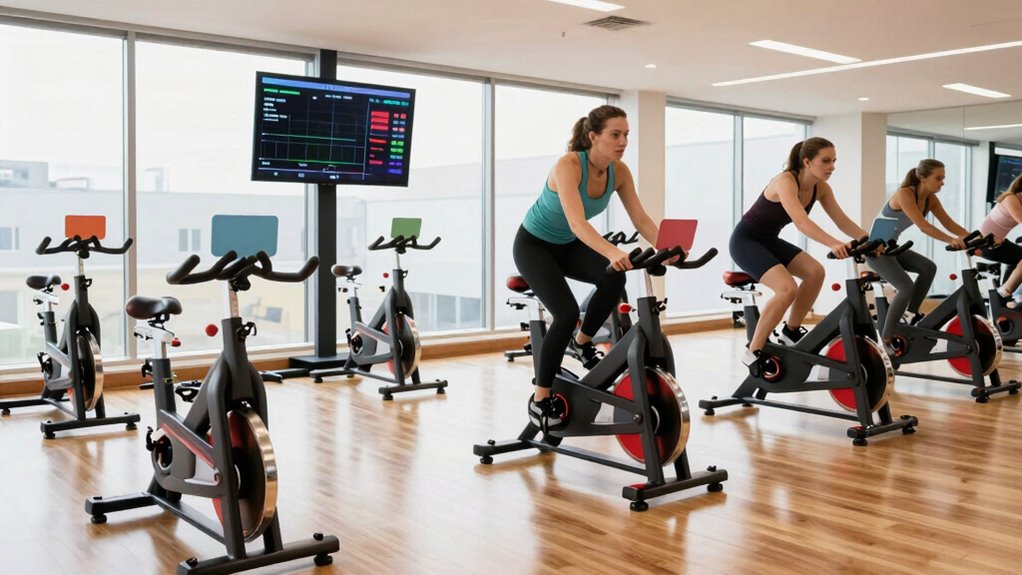

To determine your indoor cycling zones without a lab test, focus on your heart rate variability (HRV) and perceived effort during workouts. Use a compatible wearable device to monitor HRV regularly, and pay attention to how your body responds to different intensities. Stable HRV signals good recovery, while drops suggest fatigue. Combining HRV with how you feel helps you adjust your zone training confidently—keep going to discover more practical tips for personalized cycling zones.
Key Takeaways
- Use heart rate variability (HRV) and perceived effort during rides to define personalized training zones without lab tests.
- Monitor HRV regularly with wearable devices to assess recovery and adjust workout intensity accordingly.
- Observe HRV stability and responses to gauge fatigue, enabling safe zone adjustments in real-time.
- Rely on body signals and HRV data for intuitive, adaptive zone setting that aligns with current fitness levels.
- This practical approach enhances training safety, prevents overtraining, and promotes consistent progress without expensive testing.
Determining your indoor cycling zones doesn’t have to involve expensive lab tests or complicated equipment. You can establish effective zones by simply paying attention to how your body responds during your rides. One practical method is to monitor your heart rate variability (HRV), which reflects your body’s recovery status and overall stress levels. HRV can give you insights into when you’re ready to push harder or need to ease up, helping you tailor your training plan adjustments accordingly. Instead of relying solely on generic formulas or estimates, tracking your HRV over time lets you identify your personalized zone thresholds, making your workouts more efficient and safer.
Use heart rate variability to personalize and optimize your indoor cycling zones safely and effectively.
To start, you can use a heart rate monitor that tracks HRV or a compatible wearable device. As you ride, observe how your heart rate feels in relation to your perceived effort. For example, during moderate efforts, your HRV should stay within a certain range, indicating good recovery and readiness for training. When your HRV drops or indicates fatigue, it’s a sign to lower intensity or focus on recovery. Over time, this feedback helps you refine your indoor cycling zones, ensuring you’re training at the right intensity for your current fitness level. This approach makes your training more adaptable and personalized, rather than relying on generic maximum heart rate estimates that may not be accurate for everyone.
Adjusting your training plan based on HRV and perceived effort provides a dynamic way to improve. If your HRV readings suggest you’re well-recovered, you can confidently increase your intensity or duration. Conversely, if your HRV indicates stress or fatigue, it’s wise to back off and prioritize recovery, avoiding overtraining and injury. This continuous feedback loop helps you fine-tune your indoor cycling zones, ensuring each workout is both challenging and sustainable. By paying close attention to these signals, you develop a more intuitive understanding of your body’s limits and capabilities.
Additionally, incorporating personalized zone determination can significantly enhance your training effectiveness and safety. Ultimately, using heart rate variability for zone determination simplifies the process and enhances your training plan adjustments. It removes the need for costly tests and complicated calculations, making effective zone training accessible to everyone. When you incorporate HRV insights into your routine, you empower yourself to make informed decisions about intensity and recovery, leading to better performance and reduced risk of burnout. This practical approach allows you to optimize every ride, ensuring steady progress without unnecessary strain. With consistent monitoring and adjustments, you’ll soon find yourself riding smarter, not just harder, and enjoying the journey toward your fitness goals.

Trailoom Microfiber Gym Towels, Quick Dry, Highly Absorbing, Odor-Free
HIGHLY ABSORBENT - Don’t let sweat disrupt your focus. Our fiber technology absorbs moisture instantly, making it ideal...
As an affiliate, we earn on qualifying purchases.
Frequently Asked Questions
Can I Determine My Zones Without Any Equipment?
Yes, you can determine your zones without equipment by using perceived exertion. Pay attention to how hard you feel you’re working during your ride, focusing on breathing, muscle fatigue, and overall effort. As you progress, you’ll notice patterns that help you estimate your zone determination. This method relies on listening to your body, making it a practical way to gauge intensity without any gadgets.
How Accurate Are Perceived Exertion Methods?
Perceived exertion, as a subjective measurement, can be surprisingly accurate—like feeling your way through a dark room with a gentle touch. While it may not match precise lab data, many find it reliable for guiding workouts, especially with experience. Your perception of effort helps you gauge intensity, but keep in mind, factors like fatigue can influence accuracy. Regularly listening to your body improves this intuitive method.
Do Indoor Cycling Zones Change Over Time?
Yes, indoor cycling zones do change over time. As you maintain training consistency, your fitness improves, leading to zone progression. You might find yourself able to handle higher intensities or sustain efforts longer in your current zones. Regularly reassessing your perceived exertion and adjusting your zones guarantees your training stays effective and aligns with your evolving fitness level. Keep challenging yourself, and your zones will adapt accordingly.
Is Heart Rate the Best Indicator for Zones?
Heart rate is your compass, but it’s not the only guide. While it’s a solid indicator, factors like heart rate variability and your lactate threshold can provide deeper insights into your zones. Think of them as your body’s secret signals, helping you fine-tune effort levels without a lab test. By paying attention to these, you ensure your training stays precise and effective, even in the absence of high-tech measurements.
How Often Should I Reassess My Zones?
You should reassess your zones every 4 to 6 weeks to maintain training consistency and guarantee accurate zones adjustment. Regular evaluation helps you stay within the right intensity levels, preventing overtraining or undertraining. Pay attention to how you feel during rides and track your progress. Adjust your zones if you notice significant changes in your fitness or performance, keeping your training effective and aligned with your current capabilities.

Acteon Microfiber Gym Towels 5 Pack, Quick Dry Silver ION Odor-Free Sweat Towel, Super Absorbent Fast Drying for Men & Women, Workout, Yoga, Running, Hiking, Travel – 16x30.5 Inch
𝐎𝐝𝐨𝐫 𝐄𝐥𝐢𝐦𝐢𝐧𝐚𝐭𝐢𝐧𝐠: Treated with silver ions, these gym sweat towels help prevent odors while wicking away moisture fast....
As an affiliate, we earn on qualifying purchases.
Conclusion
You might think you need fancy lab tests to find your ideal cycling zones, but that’s not true. By paying attention to your perceived effort, heart rate, and how you feel during rides, you can effectively determine your zones at home. This practical approach saves you time and money, making consistent training accessible. Remember, trusting your body’s signals often provides enough guidance to improve your performance without the need for complex equipment.

Trailoom Microfiber Gym Towels, Quick Dry, Highly Absorbing, Odor-Free
HIGHLY ABSORBENT - Don’t let sweat disrupt your focus. Our fiber technology absorbs moisture instantly, making it ideal...
As an affiliate, we earn on qualifying purchases.

GEOMETRY Gym Towels for Working Out - Double Sided, Super Absorbent Microfiber Sweat Towel, Compact & Quick Dry - Premium Microfiber for Gym - Amanda, 16" x 30", 1 Piece
GEOWEAVE FABRIC: Your new favorite workout buddy! When you work out, you need a towel that can just...
As an affiliate, we earn on qualifying purchases.