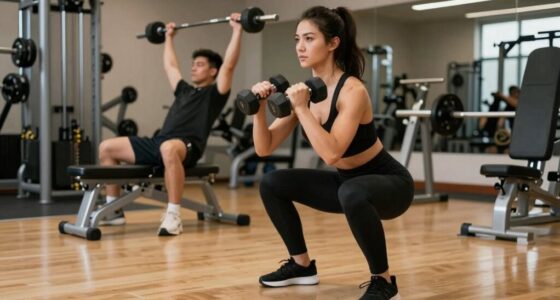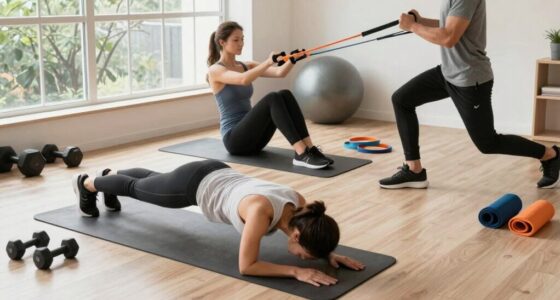
To improve pressing and rowing at home, focus on building core stability and balance first. Incorporate exercises like planks, dead bugs, and side planks to strengthen your core, which supports better control and reduces injury risk. Add unilateral movements such as single-arm presses and rows, and try unstable surfaces like balance balls to challenge your stabilizers. Consistently practicing proper breathing and balance drills can make a big difference—keep exploring how these fixes can boost your workout results.

Get workout gear delivered free — and shop member deals
- Fast, free delivery on millions of items
- Access to Prime Big Deal Days deals on October 6–7
- Prime Video, Amazon Music and more included
Key Takeaways
- Incorporate core strengthening exercises like planks and dead bugs to enhance stability for pressing and rowing.
- Use unilateral movements such as single-arm presses and rows to challenge balance and improve control.
- Perform exercises on unstable surfaces like stability balls or balance pads to activate stabilizers.
- Practice proper breathing techniques, exhaling during exertion to increase intra-abdominal pressure and support stability.
- Engage in dynamic balance drills and functional movements to transfer stability improvements to lifts.

If you struggle with stability during pressing and rowing exercises, you’re not alone—many lifters face this challenge. Stability is essential because it allows you to lift more effectively while reducing the risk of injury. The key to improving your stability often lies in balance enhancement and core activation. When your core is engaged and balanced, your body can better support the movements, making each rep more efficient and safer.
Improving stability through core activation and balance enhances safety and lifting efficiency in pressing and rowing.
To start, focus on exercises that strengthen your core. Planks, side planks, and dead bugs are simple yet powerful tools to build core activation. These exercises target your abdominal muscles, obliques, and lower back, creating a solid foundation for all pressing and rowing movements. As your core becomes stronger, you’ll notice a significant improvement in your ability to maintain proper form, especially when lifting heavier weights or performing high-rep sets.
Balance enhancement is equally essential. Incorporate unilateral exercises into your routine, such as single-arm dumbbell presses or one-arm rows. These movements challenge your stability and force your body to work harder to stay balanced. By doing so, you’ll develop better proprioception and coordination, which directly translate to improved control during bilateral movements like bench presses and bent-over rows. Engaging in stability training can further accelerate this process by targeting the muscles responsible for maintaining equilibrium. Additionally, working on dynamic balance exercises can help improve your reactions to unexpected shifts in your environment or posture. Incorporating functional movements into your training can also enhance your ability to transfer stability gains to real-life activities and lifts. Incorporating multi-directional movements can further challenge your stability and improve overall control.
Another effective way to improve stability at home is to use unstable surfaces. For example, perform push-ups on a stability ball or place your feet on a balance pad during rowing movements. These modifications force your stabilizer muscles to engage more actively, boosting your overall balance enhancement. Over time, this increased engagement helps you maintain control even when lifting heavier or when fatigue sets in.
Practicing proper breath control during your exercises also supports core activation. Exhale during exertion, such as pushing or pulling, to naturally engage your core muscles. This technique not only enhances stability but also increases intra-abdominal pressure, providing additional support for your spine and reducing injury risk. Additionally, paying attention to core stability exercises can further reinforce your ability to stay balanced during challenging lifts.
Consistency is key. Regularly dedicating time to core-focused exercises and balance drills will gradually improve your stability. As your balance enhancement and core activation become more ingrained, you’ll experience more confident pressing and rowing workouts. You’ll be able to lift with better form, control your movements more precisely, and push yourself harder without sacrificing safety. Remember, building stability isn’t an overnight process, but with focused effort, you’ll notice significant improvements that carry over into every part of your training.
stability ball for core exercises
As an affiliate, we earn on qualifying purchases.
As an affiliate, we earn on qualifying purchases.
Frequently Asked Questions
Can the Stability Fix Be Used on All Types of Flooring?
The stability fix works on most flooring types, but your floor’s compatibility depends on surface durability. It’s best suited for hard, flat surfaces like concrete or wood, which can handle the grip and weight. If you have delicate or soft flooring, like carpet or vinyl, you might need additional padding to prevent damage and guarantee stability. Always check your flooring’s surface durability before using the stability fix.
How Long Does It Take to See Improvements With the Stability Fix?
Think of your progress timeline like a garden blooming; improvements with the stability fix can appear within a few sessions, typically 1-2 weeks. Factors like your workout consistency, technique, and existing stability influence how quickly you’ll see results. Stay patient and persistent, as steady effort makes the difference. With regular use, you’ll notice better control during presses and rows, turning your home workouts into a powerhouse of progress.
Is the Stability Fix Suitable for Beginners or Only Advanced Athletes?
The stability fix is suitable for both beginners and advanced athletes. For beginners, it boosts confidence by providing extra support, helping you focus on proper form and technique. Advanced users benefit from improved stability, allowing them to push harder and lift heavier. Whether you’re just starting or already experienced, this fix enhances your stability, making pressing and rowing exercises safer and more effective for everyone.
Does the Stability Fix Require Any Special Tools for Installation?
You won’t need any fancy tools for installation, making it quite user-friendly. The stability fix generally requires minimal installation requirements, often just your hands and some basic adjustments. You can set it up easily at home without worrying about tool necessity or complicated procedures. This simplicity means you can focus on your pressing and rowing workouts sooner, enjoying improved stability without the hassle of extra equipment or technical know-how.
Can the Stability Fix Be Adjusted for Different Exercise Intensities?
Yes, the stability fix can be adjusted for different exercise intensities. You can tweak the adjustable tension to match your workout needs, making exercise customization easy. Increasing tension provides more resistance for a tougher workout, while decreasing it allows for lighter, more controlled movements. This flexibility helps you progressively challenge yourself or ease into recovery, ensuring your pressing and rowing exercises stay effective and safe at any fitness level.
balance pad for stability training
As an affiliate, we earn on qualifying purchases.
As an affiliate, we earn on qualifying purchases.
Conclusion
Think of the stability fix as your anchor amidst turbulent waters. It steadies your vessel, allowing you to navigate pressing and rowing exercises with confidence and control. Without this anchor, you risk drifting off course, losing power and balance. But with it, you become the captain of your own ship, steering through workouts with purpose and precision. Embrace this fix, and watch your strength and stability grow like a sturdy vessel weathering any storm.
As an affiliate, we earn on qualifying purchases.
As an affiliate, we earn on qualifying purchases.
Fall Picks
fall essentials
As an affiliate, we earn on qualifying purchases.