Incorporating unilateral strength exercises into your routine quickly exposes muscle weaknesses and imbalances that often go unnoticed with bilateral lifts. You’ll notice weaker or less coordinated limbs struggling to keep up, revealing hidden discrepancies. This habit highlights stabilizer muscles and dominant side dominance effortlessly. By consistently practicing unilateral training, you’ll address these weak links and improve overall movement quality, stability, and performance. Keep exploring to discover how this approach can transform your training and prevent long-term issues.
Key Takeaways
- Incorporate unilateral exercises like single-leg presses or one-arm rows to reveal strength discrepancies quickly.
- Focus on unilateral movements that require stabilization, exposing weak stabilizer muscles and imbalances.
- Monitor form and rep completion on each side to identify which limb fatigues or struggles first.
- Use unilateral testing to compare performance between limbs, highlighting dominant versus weaker sides.
- Adjust training to target identified weak links, promoting balanced muscle development and reducing injury risk.

Developing a unilateral strength habit can considerably enhance your overall fitness by targeting imbalances and increasing muscle coordination. When you focus on exercises that work one side of your body at a time, you immediately notice discrepancies between your stronger and weaker limbs. These muscle imbalances, often hidden during bilateral movements, become glaringly obvious when performing unilateral exercises. This awareness isn’t just about fixing symmetry; it’s about improving your overall movement quality, reducing injury risk, and creating a balanced physique. Functional training, which emphasizes movements used in daily life, benefits immensely from integrating unilateral work. By mimicking real-world tasks—like carrying groceries, stepping onto a curb, or reaching overhead—you train your muscles to work together efficiently, rather than relying on compensatory patterns that develop over time.
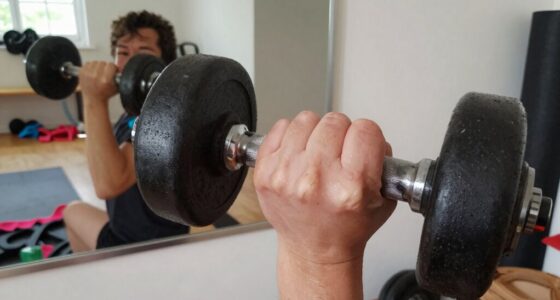
When you incorporate unilateral movements such as single-arm presses, lunges, or step-ups into your routine, you force each side of your body to bear its own load. This process quickly exposes your weak links—those muscles that struggle to keep up or stabilize properly. For instance, you might notice your dominant side completing reps effortlessly, while your weaker side falters or compensates. Recognizing these disparities allows you to tailor your training, focusing more on strengthening those lagging areas. Over time, this targeted approach not only corrects muscle imbalances but also enhances your functional capacity, making everyday tasks easier and safer. Additionally, unilateral exercises align with the principles of muscle imbalances, helping to identify and correct asymmetries that can lead to long-term issues. Incorporating movement patterns specific to daily activities ensures that your training directly benefits your everyday life. Moreover, understanding muscle activation during unilateral movements can help optimize your training for both strength and efficiency.
Engaging in unilateral strength training also sharpens your mind-muscle connection. Since each limb is working independently, you become more aware of how your muscles activate and stabilize. This heightened awareness translates into better control during compound lifts and athletic movements, boosting overall performance. Furthermore, unilateral exercises promote better core engagement because maintaining stability during these movements requires your core muscles to work harder. This integrated effort improves posture and reduces the likelihood of developing muscular asymmetries that can lead to discomfort or injury. Recognizing and addressing movement asymmetries enhances your ability to perform more complex movements safely and effectively.
As an affiliate, we earn on qualifying purchases.
Frequently Asked Questions
How Often Should I Perform Unilateral Exercises?
You should perform unilateral exercises 2-3 times weekly to address bilateral dominance and prevent muscle compensation. This frequency allows you to strengthen weaker links and improve overall balance without overtraining. Focus on controlled, slow movements to maximize effectiveness. Incorporating unilateral exercises regularly helps identify imbalances early, ensuring you build a more balanced, resilient physique while reducing the risk of injury caused by muscle compensation or dominance issues.
Can Unilateral Training Improve Overall Muscle Symmetry?
Unilateral training can dramatically improve your muscle symmetry, almost like a magic wand for muscle imbalances! By targeting each side individually, you force your weaker muscles to catch up, correcting asymmetries faster than you’d believe. This focused approach exposes weak links early, allowing you to strengthen them effectively. So yes, if you want balanced muscles, unilateral exercises are your secret weapon for symmetry correction and overall strength harmony!
Are There Risks of Imbalance With Unilateral Strength Training?
Yes, there are risks of imbalance with unilateral strength training, especially if you don’t balance exercises for both sides. Muscle asymmetry can develop if one limb outperforms the other, increasing injury risk. To prevent this, focus on equal reps and weights for each side, monitor progress, and incorporate bilateral movements. Proper technique and balanced programming help maintain symmetry, reducing injury risk and promoting overall strength.
What Equipment Is Best for Unilateral Exercises?
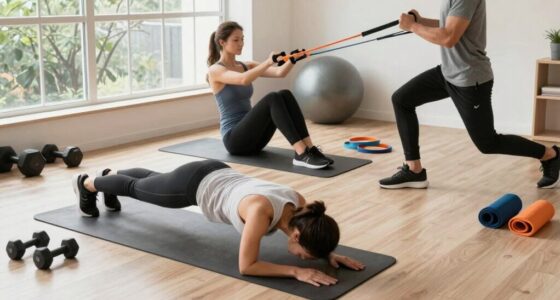
Think of equipment variety as your toolkit for revealing maximum training intensity. Dumbbells and kettlebells offer versatility and control, making them perfect for unilateral exercises. Resistance bands provide adjustable tension, ideal for targeting weak links without overloading. Cable machines give controlled movement patterns, enhancing stability and strength. By choosing diverse equipment, you can challenge your muscles effectively, revealing and strengthening weak links as you push your limits.
How Long Does It Take to See Results From Unilateral Training?
You can start seeing results from unilateral training in about 3 to 4 weeks, especially in muscle activation and injury prevention. Consistency is key; you’ll notice improved strength, balance, and coordination as your muscles work more independently. This type of training helps identify and fix weak links, reducing injury risk. Stay dedicated, and you’ll experience steady progress that enhances overall stability and muscular symmetry.

Mdeam Leg Press Hack Squat Machine,Leg Press Machine with Linear Bearing
- 2-in-1 Lower Body Machine: Adjustable foot placement for versatile workouts
- Quiet and Smooth Operation: Linear bearings ensure stable, low-noise training
- Heavy-Duty Steel Frame: Supports up to 1400lbs with durable construction
As an affiliate, we earn on qualifying purchases.
As an affiliate, we earn on qualifying purchases.
Conclusion
By neglecting unilateral strength training, you risk turning your body into a fragile, crooked tower of mismatched bricks, vulnerable to every gust of physical challenge. One weak link could cause the whole structure to wobble or collapse. Embrace the habit now, and you’ll build a fortress of balanced power, shielding yourself from sudden breakdowns. Don’t wait until your muscles betray you—train unilaterally and keep your strength fortress unbreakable.
balance and stability training equipment
As an affiliate, we earn on qualifying purchases.
As an affiliate, we earn on qualifying purchases.
core stabilization exercise tools
As an affiliate, we earn on qualifying purchases.
As an affiliate, we earn on qualifying purchases.