TL;DR

Get workout gear delivered free with Prime
- Fast, free delivery on millions of items
- Prime Video, Amazon Music and more included
- Member-only deals all year
A Fit&Well report featuring trainer Kylie Hansen draws attention to muscle power: the ability to produce force quickly, which can help with rapid movements such as recovering balance. Hansen recommends short, rested sets of adaptable exercises; the report does not provide research findings or evidence that its workout improves longevity.
Fit&Well has published a report highlighting muscle power—the ability to produce force quickly—as a fitness skill that can decline with age and inactivity, with trainer Kylie Hansen outlining a four-exercise routine aimed at practising it. The report argues that quick force production can be useful for everyday movements such as catching oneself after a trip, but it does not establish that the workout increases longevity or quantify its effects.
Hansen, identified by Fit&Well as a NASM-certified personal trainer and coach at Busy Bariatrics, distinguishes power from strength. Strength involves producing force; power involves producing it rapidly. In the report, she says the ability to move quickly can matter when someone needs to regain balance or react to an obstacle. She also says the muscle fibers involved in quick, forceful movement can decline with age and inactivity. The article does not cite a specific study or provide an age-related estimate for that decline.
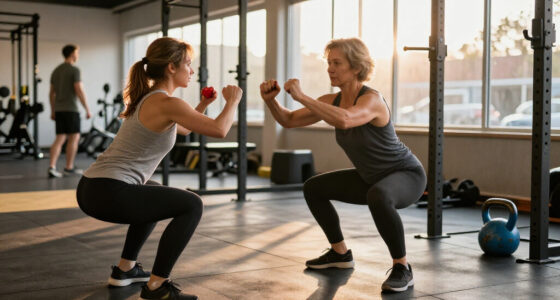
Hansen’s suggested routine includes burpees, squat jumps, squats to upright rows using dumbbells or kettlebells, and plank dumbbell pull-throughs. The first three practise explosive movement or coordinated force through the body. The pull-through is a core-stability exercise: the person shifts a dumbbell across the floor while trying to keep the trunk and hips steady. Fit&Well presents it as a complement to the faster movements, not as another jump-based exercise.
The report suggests two or three sets of each exercise, generally with five or six repetitions; the pull-through is prescribed for five or six repetitions per side. It recommends 60–90 seconds of rest between sets. Hansen advises prioritising controlled, purposeful repetitions rather than continuing until exhausted, saying performance can fall as fatigue builds. The report also offers modifications, including stepping rather than jumping in a burpee, rising onto the toes instead of jumping, and doing the pull-through from the knees.
Why Quick Force Matters Day to Day
Power is relevant to everyday function because some movements require a rapid response, not just the capacity to lift or push something once. Hansen’s examples include catching oneself after a trip and moving quickly to regain balance. That makes the report’s distinction useful for readers who already associate exercise in midlife mainly with conventional strength training: muscle power is a separate quality to practise, though the two can overlap.
The report is a trainer-led exercise feature, not a clinical guideline or a study of long-term health outcomes. Its headline links power with longevity, but the material supplied does not show that completing this particular routine extends lifespan, prevents falls, or produces a measured health benefit. The practical takeaway is narrower: the routine offers ways to practise fast, controlled movement with adjustments for different ability levels. Anyone interested should treat it as general fitness guidance, not a promise of a specific outcome.
dumbbells for muscle power training
As an affiliate, we earn on qualifying purchases.
As an affiliate, we earn on qualifying purchases.
How the Four-Move Plan Is Structured
The report places the workout within wider advice to maintain strength as people age, particularly for women in midlife, while arguing that power receives less attention. It does not present a new study, survey, medical recommendation, or official change in exercise guidance. The development is the publication of Hansen’s practical advice and the framing of power as a distinct fitness skill, rather than new evidence about how common power loss is or how a specific programme changes it.
Each exercise can be adjusted to reduce impact or complexity. A burpee can be performed by stepping the feet back and forward; a squat jump can become a rise onto the toes; and the plank pull-through can be done from the knees. The squat-to-upright-row uses weights and calls for coordination between the lower and upper body. These modifications are part of the report’s emphasis on appropriate movement and control, but it does not specify individual load choices or assess readers’ readiness to perform the exercises.
“Power drops as fatigue builds.”
— Kylie Hansen, quoted by Fit&Well
kettlebell squat jump workout equipment
As an affiliate, we earn on qualifying purchases.
As an affiliate, we earn on qualifying purchases.
What the Report Does Not Establish
The supplied report does not state when it was published, cite the research behind its claims about age-related changes in muscle fibers, or quantify how quickly those changes occur. It also does not provide evidence that the four exercises improve longevity, prevent falls, or produce a particular change in strength or power. Those outcomes should not be inferred from the workout description.
The article does not assess readers’ health, fitness, balance, joint concerns, or experience with jumping and weights. The modifications offer lower-impact options, but they are not a substitute for individual advice. People with pre-existing conditions, pain, balance problems, or uncertainty about exercise suitability can seek guidance from a qualified health or fitness professional before trying the routine.
home exercise mats for strength training
As an affiliate, we earn on qualifying purchases.
As an affiliate, we earn on qualifying purchases.
How Readers Can Apply the Advice
Fit&Well’s report offers the workout as a set of exercises readers can adapt, but it gives no follow-up schedule, progression plan, or outcome data. Readers who choose to try it can follow the stated approach of short sets and 60–90 seconds of rest, use the lower-impact options where appropriate, and stop if a movement causes pain or feels unsafe. The report’s stated priority is crisp, controlled repetitions rather than exhaustion.
No new research or official guidance is announced in the source material. Whether this specific routine helps maintain power over time, and how it compares with other exercise programmes, remains unreported. For now, the story is best understood as expert-led fitness advice drawing attention to a less-discussed training goal, not as evidence of a proven longevity intervention.
adjustable dumbbell set for midlife fitness
As an affiliate, we earn on qualifying purchases.
As an affiliate, we earn on qualifying purchases.
Key Questions
What does muscle power mean?
In Hansen’s definition, power is the ability to produce force quickly. It differs from strength alone because speed is part of the movement.
Which exercises does the report recommend?
The routine includes burpees, squat jumps, squats to upright rows, and plank dumbbell pull-throughs. The first three focus on faster force production or coordination; the pull-through challenges core stability.
How many sets and repetitions are suggested?
The report recommends two or three sets, generally of five or six repetitions, with 60–90 seconds of rest between sets. Pull-throughs are prescribed for five or six repetitions on each side.
Does the report prove this workout increases longevity?
No. The supplied material describes a trainer’s workout advice but presents no study or outcome data showing that the routine extends lifespan or prevents falls.
Can the exercises be modified?
Yes. The report suggests stepping through burpees instead of jumping, rising onto the toes instead of doing squat jumps, and performing plank pull-throughs from the knees. People with pre-existing conditions or concerns about safety can seek professional guidance before starting.
Source: rss
Halloween Picks
halloween
As an affiliate, we earn on qualifying purchases.