TL;DR

Get workout gear delivered free — and shop member deals
- Fast, free delivery on millions of items
- Access to Prime Big Deal Days deals on October 6–7
- Prime Video, Amazon Music and more included
A Fit&Well writer reports introducing his 73-year-old father to a brief strength routine built around goblet squats, single-arm rows and overhead presses. The article describes the exercises and easier variations, but does not report measured results or provide a clinical training plan.
Fit&Well has published a personal account of a three-move dumbbell routine a writer introduced to his 73-year-old father, who had let strength training slide while caring for his wife, who has Parkinson’s. The routine pairs goblet squats, single-arm rows and overhead presses; the account describes its intended everyday uses, not measured results from a formal study.
The writer says his father had been active but had recently neglected strength work because of limited time while caring for his mother. The writer, describing himself as a personal trainer, bought him light-to-medium dumbbells and reviewed basic lifting technique, including keeping a weight close to the chest, bracing the core and staying upright.
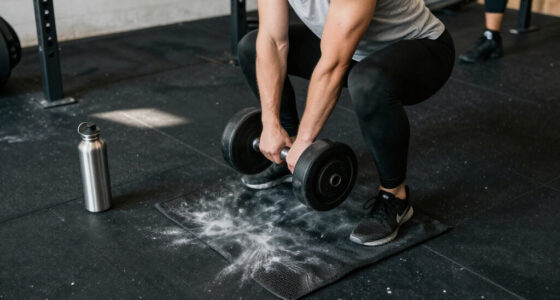
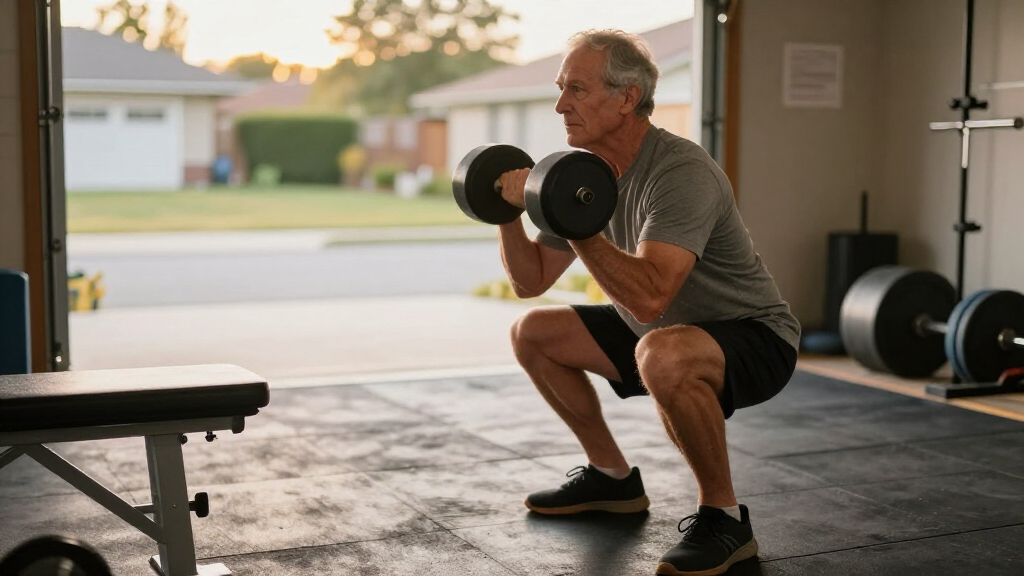
Before adding weights, they spent a few weeks practicing bodyweight movements, including squats, hip hinges, lunges and pushing movements. The resulting routine has three exercises: the dumbbell goblet squat, which targets the legs and core; the single-arm dumbbell row, a pulling movement for the back and shoulders; and the overhead press, which trains pushing strength.
For each exercise, the article suggests three sets of eight to 12 repetitions. It also offers lower-demand alternatives: a bodyweight or chair-assisted squat, a kneeling row for added stability, and a seated press with back support or a one-arm press. These are instructions from the personal account, not a claim that the same repetitions or weights suit everyone.
Strength for Everyday Tasks
The routine is framed around strength used in ordinary activities, rather than athletic performance. The article links squatting to standing from a chair or bending to pick something up, rows to lifting bags, and overhead presses to reaching shelves, lifting objects and dressing. That focus may help readers understand why basic resistance movements can be relevant beyond a gym setting.
The account also highlights the practical constraint behind the plan: the father has limited time because of caregiving responsibilities. A short list of movements may feel more manageable than a longer program, but the source gives no information about how long each session takes, how often he performs it, or whether he has maintained the routine.
Its scope remains limited. This is one writer’s description of training a family member, not a controlled assessment of strength, mobility, balance or injury risk. The account does not establish that the routine produces particular health outcomes for older adults generally.
As an affiliate, we earn on qualifying purchases.
How the Routine Was Introduced
The writer says he started with technique and unweighted practice before introducing dumbbells. That sequence matters to the account: the three exercises were not presented as a first-day test, but as the next step after several weeks of practicing movement patterns. The source does not specify the father’s medical history, prior strength-training experience, or the exact weights used.
The article’s exercise instructions include ways to reduce the challenge, such as using a chair for support or performing a row in a kneeling position. It also describes increasing the press difficulty with heavier weights or a push press, but those options are not reported as part of the father’s actual routine. Readers should distinguish those general exercise suggestions from what the writer says his father did.
lightweight dumbbell set for strength training
As an affiliate, we earn on qualifying purchases.
As an affiliate, we earn on qualifying purchases.
Results and Training Details
The report does not say how often the father completes the exercises, what dumbbell weights he uses, how long sessions last, or whether his strength or mobility has changed. It also does not provide measurements, follow-up results or an independent evaluation. The described benefits are the writer’s rationale for choosing the movements, not outcomes shown in the account.
It is also unclear whether the father received medical or rehabilitation guidance, or whether he has conditions that affect his ability to exercise. The article is not a personalized prescription. Anyone with a health condition, pain, balance concerns or uncertainty about safe lifting should seek guidance from a qualified health professional before starting or changing a strength routine.
As an affiliate, we earn on qualifying purchases.
Progressing at a Safe Pace
The source does not announce a follow-up or a planned assessment of the father’s progress. Its practical guidance is to begin with easier versions when needed and only add resistance or difficulty when the movement can be performed comfortably and with control. Readers who try similar exercises can treat the listed sets and repetitions as the article’s example, not a requirement.
A next step for the father would depend on his own comfort, ability and schedule; the report does not say what he plans to do. For older adults, especially those managing health conditions or returning to exercise, an individualized plan from a qualified professional can help account for strength, balance and safety.
As an affiliate, we earn on qualifying purchases.
Key Questions
Which three exercises are in the routine?
The routine includes a dumbbell goblet squat, a single-arm dumbbell row and a dumbbell overhead press.
How many sets and repetitions does the article suggest?
For each exercise, the article lists three sets of eight to 12 repetitions. That is the source’s suggested format, not a universal prescription.
Did the article show that the routine improved the father’s strength?
No measured results are reported. The piece describes why the writer chose the exercises but does not provide before-and-after strength or mobility data.
What easier versions does the article describe?
It suggests a bodyweight or chair-assisted squat, a kneeling row for stability, and a seated overhead press with back support or a one-arm press. People with health concerns should get professional guidance before exercising.
Source: rss
Fall Picks
fall essentials
As an affiliate, we earn on qualifying purchases.