
TL;DR

Get workout gear delivered free with Prime
- Fast, free delivery on millions of items
- Prime Video, Amazon Music and more included
- Member-only deals all year
Fit&Well reports that physical therapist Erin Cannon recommends thread the needle, banded shoulder external rotations and shoulder CARs as mobility exercises for maintaining shoulder range of motion. Cannon suggests two to three sets of five to 10 repetitions, three times a week, while advising people with injuries or mobility concerns to speak with a doctor first.
Physical therapist Erin Cannon recommends three mobility exercises—thread the needle, banded shoulder external rotations and shoulder CARs—to help people maintain shoulder range of motion as they age. In a report by Fit&Well, Cannon advises doing two to three sets of five to 10 repetitions, three times a week, while telling people with injuries or mobility concerns to consult a doctor before trying them.
The exercises use different movements to work the shoulder and surrounding area. Thread the needle combines a torso rotation with reaching an arm overhead and then beneath the body. Banded external rotations use a resistance band while the elbows stay bent and close to the sides. Shoulder CARs, or controlled articular rotations, involve slowly moving one arm through a comfortable circle.
Cannon’s general guide is two to three sets of five to 10 repetitions, three times weekly. For exercises performed on one side at a time, the report specifies five to 10 repetitions per side. Cannon says the appropriate number of sets and repetitions can vary from person to person; people new to regular exercise are advised to begin at the lower end and build gradually.
The report says a mat and resistance band are needed for the three-move routine. Cannon emphasizes maintaining an upright posture and engaging the core, with adjustments for each movement: avoid excessive spinal rounding or arching during thread the needle, keep the elbows near the torso during banded rotations, and move only through a comfortable range during shoulder CARs.
Mobility for Everyday Shoulder Use
Shoulder discomfort can make ordinary tasks, including getting dressed and putting away shopping, more difficult, according to the Fit&Well report. Its practical focus is on controlled movement that can be done at home with limited equipment, rather than a claim that the exercises prevent all shoulder problems.
Cannon says the exercises can help maintain range of motion and encourage circulation to the joint. Those are the physical therapist’s stated aims, not evidence in the supplied report that the routine prevents injuries or treats a particular condition. The suggested frequency is a general starting point; individual needs and tolerances differ.
The distinction matters for readers deciding whether to add the movements to a routine. The report includes form guidance and advises medical consultation for people with injuries or mobility concerns, but it does not provide individualized assessment. Comfort and controlled movement are central to the instructions, particularly for the circular arm movement, which should stay within a person’s comfortable range.
Products Worth Considering

Bowflex SelectTech 840 Adjustable Kettlebell

Therabody Theragun Prime 6th Generation Deep Tissue Massage Gun, Navy

Levoit Core 400S-P Smart Air Purifier for Large Rooms
As an affiliate, we earn on qualifying purchases.
How the Three Moves Differ
The report places the exercises within a broader approach to shoulder care: strengthening the muscles around the joint may help avoid injury, while regular mobility work is intended to keep the shoulder moving. That framing comes from the Fit&Well report and should not be read as a guarantee of injury prevention.
Thread the needle starts on hands and knees. The person rotates the torso, reaches one arm toward the ceiling, then brings that shoulder toward the mat while sliding the arm under the body. The movement is repeated on both sides, with the core engaged and without excessive rounding or arching of the spine.
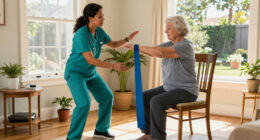
For banded external rotations, a person stands with feet hip-width apart, bends the elbows to about 90 degrees and keeps them at the sides while pulling the band apart through shoulder rotation. The band returns to its starting position after a brief pause. The report suggests placing a rolled towel between an elbow and the torso if keeping the elbow close is difficult.
In shoulder CARs, the arm moves slowly through a circle, first leading with the thumb and then reversing direction while leading with the pinky. The person repeats the movement on the other side and avoids forcing the arm beyond a comfortable range. For all three movements, Cannon stresses posture and core engagement.
“A general standard to follow could be two to three sets of five to 10 reps, three times per week.”
— Erin Cannon, physical therapist with Hackensack Meridian JFK Johnson Rehabilitation Institute, as quoted by Fit&Well
Limits of the Exercise Guidance
The supplied report does not state when it was published, cite a clinical trial of this specific three-exercise routine or establish that it prevents shoulder injuries. Cannon’s recommendations are presented as general guidance, not a personalized program. The report also does not specify how the routine should be changed for a particular diagnosis, level of pain or range-of-motion limitation.
It is also unclear how readers should progress beyond the suggested repetition range or how long to continue the routine. The report advises starting at the lower end for people new to regular exercise and speaking with a doctor before attempting the moves if they have an injury or mobility concern. It does not provide further screening criteria or an alternative routine for people who cannot perform one of the exercises comfortably.
Starting With a Comfortable Range
Readers considering the exercises can use Cannon’s repetitions and weekly frequency as a general starting point, rather than a prescription. The report’s next practical step is to begin with fewer repetitions if new to exercise, keep movements controlled, and avoid pushing through an uncomfortable range.
People with existing injuries or mobility concerns should speak with a doctor before trying the routine, as the report advises. Fit&Well does not describe a formal follow-up, additional testing or a promised outcome; any decision to adjust the exercises would depend on an individual’s needs and professional guidance.
Key Questions
Which three shoulder mobility exercises does the report recommend?
Thread the needle, banded shoulder external rotations and shoulder CARs are the three exercises recommended by physical therapist Erin Cannon in the Fit&Well report.
How often does Cannon suggest doing the exercises?
Cannon offers a general guide of two to three sets of five to 10 repetitions, three times a week. She says the appropriate amount can differ between people.
What equipment is needed?
The report says to use an exercise mat and a resistance band. The band is used for the external-rotation exercise; the other two are described as bodyweight movements.
What should someone do if they have an injury or mobility concern?
The report advises speaking with a doctor before attempting the exercises if you have an injury or mobility concern. It does not offer individualized modifications for specific conditions.
Source: fitandwell.com