TL;DR

Get workout gear delivered free with Prime
- Fast, free delivery on millions of items
- Prime Video, Amazon Music and more included
- Member-only deals all year
Fit&Well published a lower-body routine built around forward, side and curtsy lunges, recommending 6–8 repetitions per leg and 2–3 sets of each movement. The writer says the sequence can be done with dumbbells or bodyweight, but the report does not provide research showing that doing it once a week will build glute strength for everyone.
Fit&Well has outlined a dumbbell leg workout combining forward, side and curtsy lunges, recommending two or three sets of six to eight repetitions per leg for each movement. The report presents the sequence as a way to train the glutes from different directions, while also offering a bodyweight option; it does not establish that one weekly session will produce the same results for every person.
The workout is built around three lunge patterns: a forward lunge, a lateral or side lunge, and a curtsy lunge, in which one foot steps behind and across the other. Fit&Well’s writer says the variations can be combined as a lower-body session or fitted into a broader weekly workout plan. The suggested prescription is six to eight reps on each leg for each exercise, with two or three sets in total.
For the forward lunge, the instructions are to step ahead, bend both knees and lower while keeping the front knee over the foot and the chest upright, then push through the front foot to stand. In the side lunge, step out to one side, bend that knee and send the hips back while keeping the other leg straight. For the curtsy lunge, step one foot back and across behind the other, bend both knees, then push through the front foot to return. The report advises lowering only as far as is comfortable.
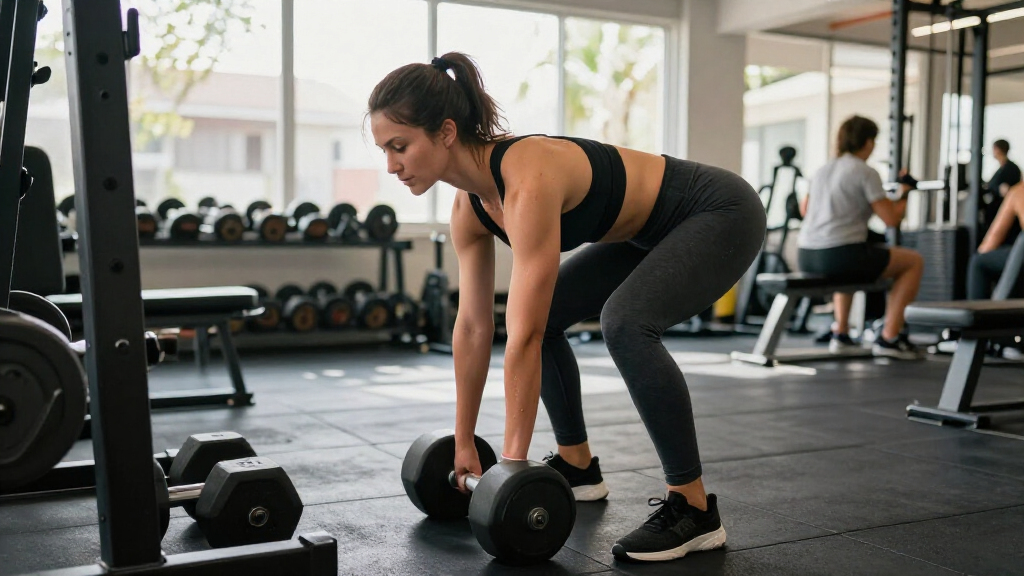
Readers can hold dumbbells at their sides or on their shoulders, or hold one weight at the chest. The sequence can also be done without weights, with repetitions adjusted so the final few feel challenging, according to the report. For weighted sessions, the writer recommends first completing a bodyweight round as a warm-up and increasing the load gradually, rather than starting with heavy weights.
How Three Lunges Change the Workout
The routine’s practical appeal is that it combines three directions of movement in a short sequence, rather than relying only on a forward-and-back pattern. The report says the variations target the gluteus maximus, medius and minimus, muscles involved in hip movement and stability. That is the writer’s rationale for including the side and curtsy lunges alongside the forward lunge; the article does not cite a comparative trial showing how much each version activates those muscles.
For readers planning a strength session, the program offers a clear starting point for sets, repetitions and equipment choices. It also leaves room to scale the work: bodyweight can be used before adding resistance, and people who find alternating repetitions difficult can finish one side before switching. Those options may make the sequence easier to adapt, but they are not a guarantee of results or a substitute for an individualized training plan.
Fit&Well’s writer also says the side and curtsy lunges engage muscles and ligaments around the core and lower spine, and describes the changing directions as useful for hip and ankle mobility and stability. These are the writer’s reported benefits, not outcomes established for all participants in the supplied material. The article does not specify a training study, participant group or measured strength change.
Products Worth Considering

BowFlex Results Series SelectTech Adjustable Dumbbells (Pair)

Bowflex SelectTech 840 Adjustable Kettlebell

Levoit Vital 100S-P Air Purifier with Washable Pre-Filter
As an affiliate, we earn on qualifying purchases.
The Report’s Weekly Training Advice
The headline promotes doing the workout once a week, while the supplied article describes adding the sequence to a weekly program alongside other exercises or performing it as a standalone “exercise snack.” The writer says they often do it at the end of the working day. That personal account explains how the routine fits into their schedule; it is not evidence that once weekly is an ideal frequency for everyone.
The report frames lunges as a complement to squats. Its writer says squats are useful for building leg strength but that lunges can target parts of the glutes that squats may not reach in the same way. It names the gluteus maximus, medius and minimus and briefly describes their roles in hip movement and pelvic stability. No sources or detailed evidence review are included in the supplied text to quantify differences between the exercises.
The writer also mentions personal rehabilitation after a diagnosis of a bulging disc, saying the side and curtsy lunges had been helpful to them. That is an individual experience, not clinical guidance or proof that the sequence is suitable for people with back conditions. Readers with injuries, pain or health concerns should seek advice from a qualified health professional before changing their exercise routine.
““The forward lunge, lateral (side) lunge and curtsy (reverse and rotational) lunge, together target all three muscles in your glutes.””
— Fit&Well report writer
What the Routine Cannot Establish
The supplied report does not give a publication date, cite a controlled study or report measured outcomes from people following the routine. It is therefore unclear what evidence supports the headline’s once-a-week frequency, how long someone would need to train to see a change, or how results might differ according to starting fitness, technique, load and recovery. The article’s benefits are presented through the writer’s explanation and personal experience, not as guaranteed effects.
It is also not clear what weight readers should use, how much rest to take between sets, or how the workout should progress over time beyond gradually increasing the load. The recommendations do not address individual limitations or injuries. Anyone who experiences pain, has a history of injury or is unsure whether lunges are appropriate should pause and consult a qualified professional.
How Readers Can Apply the Plan
The report offers a session template rather than a longer training program. Readers following it can begin with a bodyweight warm-up round, practise controlled repetitions and add light dumbbells only if the movements feel manageable. The listed target is six to eight repetitions per leg for each lunge, repeated for two or three sets; the instructions do not prescribe a specific rest interval.
People incorporating the sequence into a weekly routine will need to decide how it fits alongside their other lower-body training and recovery. The article provides no follow-up results or planned update, so whether the routine builds strength for an individual will depend on their training and cannot be confirmed from this report alone.
Key Questions
What exercises are in the workout?
The routine includes a forward lunge, side lunge and curtsy lunge, performed on both legs.
How many sets and repetitions does the report recommend?
Fit&Well recommends six to eight repetitions per leg for each exercise, completing two or three sets in total.
Do I need dumbbells?
No. The report says the sequence can be performed with bodyweight. Dumbbells may be held at the sides or shoulders, or one weight can be held at the chest. It advises starting with a bodyweight round before weighted work.
Does the report prove that once a week is enough to build glutes?
No. It proposes a weekly routine but provides no study or measured results establishing that frequency as sufficient for everyone. The writer’s stated benefits and personal experience should not be treated as a guarantee.
Source: fitandwell.com