To get stronger at home without changing your program every week, focus on gradually increasing the challenge of your current exercises. You can do this by adding reps, slowing down movements, or holding positions longer. Small tweaks—like elevating your feet or performing slower reps—keep your muscles adapting. Stay consistent and make subtle adjustments instead of switching routines. Keep this approach in mind, and you’ll discover more effective strategies to boost your strength over time.
Key Takeaways
- Gradually increase exercise difficulty by adding reps, sets, or slowing down movements to ensure continuous overload.
- Make small modifications, like elevating feet or pausing, instead of switching routines frequently.
- Focus on perfecting form and mastering basic movements before progressing to advanced variations.
- Maintain consistency in your workouts to allow your body to adapt and grow stronger over time.
- Track progress and subtly challenge muscles to prevent stagnation without changing the overall program.

Ever wondered how you can build strength without a gym? The good news is, you don’t need fancy equipment or a membership to get stronger. With just your body weight and a smart approach, you can make consistent progress right at home. The key is understanding how to apply the principle of progressive overload—gradually increasing the difficulty of your exercises over time. This approach guarantees your muscles are continually challenged, which is vital for strength gains. Instead of constantly switching exercises or programs every week, focus on how to make what you’re already doing harder in a manageable way.
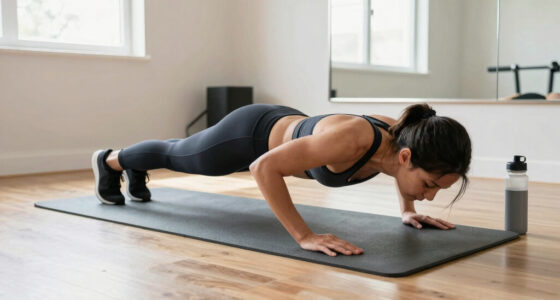
Start by mastering basic movements like push-ups, squats, lunges, and planks. These exercises form a solid foundation, and because they use your body weight, they’re accessible and safe. Once you’re comfortable with a movement, you can increase its difficulty without changing the exercise altogether. For example, if standard push-ups become too easy, try elevating your feet or performing archer push-ups. For squats, you can add pauses at the bottom or slow down the movement to increase intensity. The goal is to challenge your muscles just enough that they adapt and grow stronger, without risking injury or burnout.
Master basic movements and gradually increase difficulty to build strength safely at home.
Progressive overload doesn’t mean you have to do more reps every day. Instead, it’s about making subtle adjustments to increase difficulty over time. You might increase the number of reps, add more sets, or slow down your tempo. For instance, if you’re doing planks, you can extend the duration gradually. If you’re doing lunges, you can hold a single-leg position longer or add a jump between reps. These small adjustments keep your training progressive overload and effective, without the need to overhaul your entire program. Incorporating strategies like muscle adaptation allows your body to respond positively to the incremental challenges you set. Additionally, understanding the importance of training consistency will help you stay committed and see steady progress over time.
Building muscle and strength also depends on how well your body adapts to training stimuli, making it crucial to continually find the right level of challenge.

MQRW Push Up Board,Home Gym,Portable Exercise Equipment,Pilates Bar and 20 Fitness Accessories with Resistance Bands and Ab Roller Wheel,Full Body Workout at Home
【Workout Equipment System】Portable Exercise Pack is used with various workout equipment attachments:Foldable Push up board,3-section Bar,6 Resistance Bands,…
As an affiliate, we earn on qualifying purchases.
As an affiliate, we earn on qualifying purchases.
Frequently Asked Questions
Can I Build Muscle Without Using Weights?
Yes, you can build muscle without weights by focusing on resistance training with your body weight. Exercises like push-ups, squats, lunges, and planks boost muscle endurance and strength. Consistently challenging yourself with variations and increasing repetitions helps stimulate growth. You don’t need weights—your body weight provides enough resistance to develop muscle, improve endurance, and stay strong right at home.
How Long Should I Rest Between Sets?
Think of your muscles as batteries that need recharging. Rest period, or the time you take between sets, should match your training intensity. For maximum strength gains, rest for 1-2 minutes during high-intensity sets; if you’re aiming for endurance, extend it to 30-60 seconds. Listen to your body—if you feel ready sooner or need longer, adjust accordingly. Proper rest keeps your energy charged and your progress unstoppable.
Is It Necessary to Increase Workout Difficulty Weekly?
Yes, increasing workout difficulty weekly isn’t necessary if you focus on consistent workouts and progressive overload. You can safely improve strength by gradually adding reps, sets, or increasing resistance, maintaining workout consistency. This steady progression challenges your muscles enough for growth without constantly changing your routine. Remember, patience and consistency are key—small, regular increases over time lead to significant strength gains without risking burnout or injury.
How Do I Stay Motivated Doing the Same Routine?
You might think sticking to the same routine kills motivation, but consistency can actually boost your confidence and progress. To stay motivated, focus on routine variation by setting small goals, tracking your improvements, and celebrating milestones. Remember, motivation fluctuates, but building discipline keeps you moving. Keep your workouts fresh mentally by experimenting with reps or tempos, even if the core routine stays the same—this keeps your motivation high and your progress steady.
Can I Improve Strength With Bodyweight Exercises Only?
Yes, you can improve strength with bodyweight exercises by applying progressive overload and focusing on functional movement. Challenge yourself by increasing reps, slowing down movements, or adding pauses to make exercises harder. Incorporate functional movements like push-ups, squats, and planks to build strength that transfers to daily activities. Consistently pushing your limits and ensuring proper form will help you see progress without needing equipment or changing routines frequently.

WHATAFIT Resistance Bands,Exercise Bands,Workout Bands with Handles,Door Anchor and Ankle Straps,5 Resistance Levels Fitness Bands,for Strength,Training, Physical Therapy, and Home Gym Equipment
5 Adjustable Resistance Levels for Versatile Training: This resistance bands set includes 5 color-coded bands with individual poundage…
As an affiliate, we earn on qualifying purchases.
As an affiliate, we earn on qualifying purchases.
Conclusion
Stick with your routine and focus on gradual progress—you don’t have to reinvent the wheel every week. Consistency is key, and over time, those small improvements will add up to real strength. Remember, Rome wasn’t built in a day, so patience pays off. Keep pushing, stay dedicated, and you’ll see results without constantly changing your program. Your strength journey is a marathon, not a sprint—stay the course and enjoy the ride.

A AZURELIFE Exercise Core Sliders, Dual Sided Exercise Gliding Discs Use on Carpet or Hardwood Floors, Light and Portable, Perfect for Abdominal&Core Workouts
Dual-sided Design: The Smooth (Plastic) Side for Most Carpets or Other Blanket(not all surfaces), and The Foam Material…
As an affiliate, we earn on qualifying purchases.
As an affiliate, we earn on qualifying purchases.

Fitness Workout Journal for Women & Men, A5(5.5" x 8.2") Workout Log Book Planner for Tracking, Progress, and Achieving Your Wellness Goals – Green
Track Your Workouts – Stay organized and record your gym workouts with this comprehensive fitness planner. It provides…
As an affiliate, we earn on qualifying purchases.
As an affiliate, we earn on qualifying purchases.