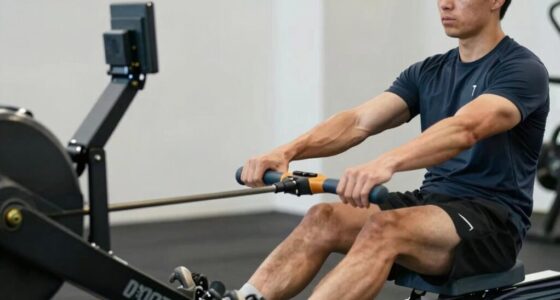

To master rowing form, you start with the catch: extend your arms, lean forward, knees bent, and set your body in a strong, balanced position. Execute a powerful drive by pushing with your legs, engaging your core, and then smoothly pull the handle towards your chest at the finish, before relaxing and recovering by extending your arms, leaning forward, and extending your legs. Focusing on these steps and maintaining rhythm will boost your efficiency—keep going to learn how to perfect each phase.

Get workout gear delivered free with Prime
- Fast, free delivery on millions of items
- Prime Video, Amazon Music and more included
- Member-only deals all year
Key Takeaways
- Follow the sequence: catch, drive, finish, and recovery for consistent and efficient rowing technique.
- Proper catch position involves knees bent, body leaning forward, arms extended; sets the foundation for power.
- Execute a powerful drive by pushing with legs, engaging core, and maintaining back and arm control.
- During the finish, smoothly pull handle to chest, relax shoulders, and control body lean; then recover with controlled, fluid motion.
- Correct common mistakes like overreaching or rushing to build good habits and improve overall rowing efficiency.
indoor rowing machine with adjustable resistance
As an affiliate, we earn on qualifying purchases.
As an affiliate, we earn on qualifying purchases.
Understanding the Basic Sequence of Rowing

Have you ever wondered what makes a smooth and efficient rowing stroke? It all starts with understanding the basic sequence. First, you begin at the catch, where you prepare to drive by placing your oars into the water with your arms extended and your body leaning slightly forward. Next comes the drive, where you push through your legs, engage your core, and pull the oar towards your chest. Then, you reach the finish, where you release the handle and prepare to recover. Finally, during recovery, you swing back to the starting position, allowing your body to reset. This repeating cycle keeps your rhythm steady and ensures you’re using your energy effectively. Mastering this sequence is crucial to improving your rowing efficiency. Additionally, incorporating energy-efficient techniques can help optimize your performance while conserving your effort. Understanding proper technique is essential for reducing fatigue and preventing injury during your sessions. To further enhance your efficiency, paying attention to smooth transitions between each phase can make your stroke more fluid and effective.
As an affiliate, we earn on qualifying purchases.
The Importance of the Catch Position

The catch position is the foundation of a strong and efficient rowing stroke. It sets the stage for power and smoothness throughout your entire row. When you reach the catch, your knees are bent, your body is leaning slightly forward, and your arms are extended toward the oar. It’s vital to verify your catch is neither too early nor too late, as this affects the timing and fluidity of your stroke. A proper catch allows you to engage your legs, back, and arms effectively, maximizing power transfer. If your catch is off, you risk losing momentum or introducing unnecessary strain. Focus on starting each stroke with precision at the catch, establishing a stable, balanced position that promotes consistency and efficiency in every pull. Proper body alignment and body jewelry measurements can also help maintain a comfortable and effective position during each stroke. Additionally, maintaining proper timing and coordination ensures that each part of your body contributes optimally to the stroke cycle. Incorporating awareness of your muscle engagement can further enhance your technique and prevent injury.
As an affiliate, we earn on qualifying purchases.
Executing a Powerful and Smooth Drive

A strong and smooth drive begins the moment you push off with your legs, transferring power efficiently from your lower body through your core and into the oar. Focus on driving your legs straight and forcefully, keeping your back straight and engaged. As your legs extend, your hips should hinge forward slightly, maintaining a steady, controlled motion. Avoid rushing or jerking; instead, aim for a consistent, fluid transfer of power. Your arms should stay relatively relaxed during this phase, with most effort coming from your legs and core. Keep your shoulders down and avoid overusing your arms early. A smooth, powerful drive maximizes propulsion while conserving energy, setting the stage for an effective finish. Additionally, understanding proper biomechanics can help optimize your technique and reduce the risk of injury. Incorporating technique fundamentals into your training ensures a more efficient and injury-free rowing experience. Developing awareness of muscle engagement can also enhance your power transfer and overall consistency. Paying attention to rowing rhythm can help keep your strokes smooth and synchronized throughout your session. Building timing awareness further enhances your ability to execute each phase seamlessly.
training guide for proper rowing form
As an affiliate, we earn on qualifying purchases.
As an affiliate, we earn on qualifying purchases.
Proper Finish Technique for Maximal Efficiency

To achieve maximum efficiency during the finish, focus on controlling the movement as your arms extend and your body leans back slightly. Keep your shoulders relaxed and avoid overextending or jerking the handle. Your wrists should stay flat, and your grip firm but gentle. Engage your core to maintain stability, and pull the handle towards your lower chest or ribs smoothly. Ensure your elbows stay close to your sides, preventing any flaring out. As you lean back, avoid tilting excessively or losing posture. Proper finish positioning reduces wasted energy and prepares you for a smooth recovery. Thermal behavior plays a role in how efficiently you execute this motion, ensuring minimal energy loss. Additionally, paying attention to muscle engagement helps maintain control and conserves energy throughout the stroke. Being mindful of your body mechanics ensures optimal transfer of power and prevents fatigue. Proper technique can further enhance your rowing efficiency and reduce the risk of injury. Incorporating consistent training practices can also contribute to maintaining proper form over time.
The Recovery Phase: Releasing and Resetting

As you finish the drive phase, focus on smoothly releasing the handle and resetting your body for the next stroke. Begin by relaxing your arms and allowing the handle to move forward naturally, maintaining control. Lean your body gently forward from the hips, preparing to slide back into the catch position. Your legs should extend fully without rushing, ready to absorb the next pull. Use this *shift* to stay balanced and maintain momentum. Properly resetting minimizes unnecessary movement and keeps your stroke efficient. Incorporating precision in your recovery ensures consistent and effective transitions between strokes.
Common Mistakes to Avoid in Each Phase

One common mistake is losing rhythm or timing, which can throw off your entire stroke. You also want to avoid overreaching or underreaching during the catch phase, as both can cause strain or inefficiency. Staying consistent and precise helps you maintain power and smoothness throughout each stroke.
Poor Timing and Rhythm
Have you ever noticed how poor timing and inconsistent rhythm can disrupt your rowing efficiency? When your movements aren’t synchronized, your power diminishes, and fatigue sets in quicker. You might find yourself rushing through the catch, pulling too early or late, or losing sync during the drive. This interrupts the flow and prevents smooth progression between phases. Common issues include:
- Starting the drive before the legs fully extend
- Lifting the handle too early during recovery
- Falling out of sync with your breathing
- Moving unevenly between strokes
- Hesitating between phases, breaking rhythm
Additionally, maintaining proper timing and rhythm is essential for conserving energy and avoiding injury. These mistakes lead to wasted energy and reduced momentum. To improve, focus on maintaining a steady, fluid rhythm, ensuring each phase flows seamlessly into the next, maximizing rowing efficiency and power. Developing a consistent pace helps prevent energy wastage and keeps your stroke smooth. Recognizing and correcting rhythm disruptions can significantly enhance overall performance. Paying attention to your stroke timing can also help you identify and correct inconsistencies more effectively.
Overreaching or Underreaching
Overreaching or underreaching can considerably hinder your rowing efficiency if you’re not careful. When you overreach, you extend too far at the catch, which puts unnecessary strain on your back and shoulders, reducing power transfer. Conversely, underreaching means you don’t extend enough, limiting your stroke length and decreasing propulsion. Both mistakes disrupt your rhythm and waste energy. To avoid this, focus on a balanced, controlled reach that feels natural and comfortable. Your arms should extend smoothly without overextending, and your body should move forward with ease. Maintain awareness of your body position throughout the catch. Practicing proper reach ensures maximum power application and smooth transitions into the drive phase, making your rowing more effective and injury-free. Incorporating body awareness and proper technique can further enhance your efficiency and prevent strain. Developing neuromuscular control can also help you maintain proper form and avoid common mistakes. Additionally, understanding your biomechanics allows you to optimize your movement and reduce the risk of overuse injuries.
Building Good Habits for Consistent Form

Building good habits is essential for maintaining consistent rowing form, especially when you’re aiming to improve performance and prevent injury. Developing routines helps your body remember proper movements and reduces errors during each stroke. To build these habits, focus on intentional practice and mindfulness. Consistently remind yourself of key form cues, like engaging your core at the right moments or maintaining a smooth rhythm. Establishing a routine before each session can reinforce muscle memory.
Building consistent habits enhances rowing form, performance, and injury prevention through mindful practice and routine reinforcement.
Picture this:
- Starting each session with a quick warm-up emphasizing technique
- Using video or mirror feedback for self-correction
- Tracking your form progress daily
- Practicing drills that isolate specific movements
- Ending your session with a review of key form points
These habits create a foundation for reliable, efficient rowing.
Tips for Improving Your Technique on the Water and in the Gym
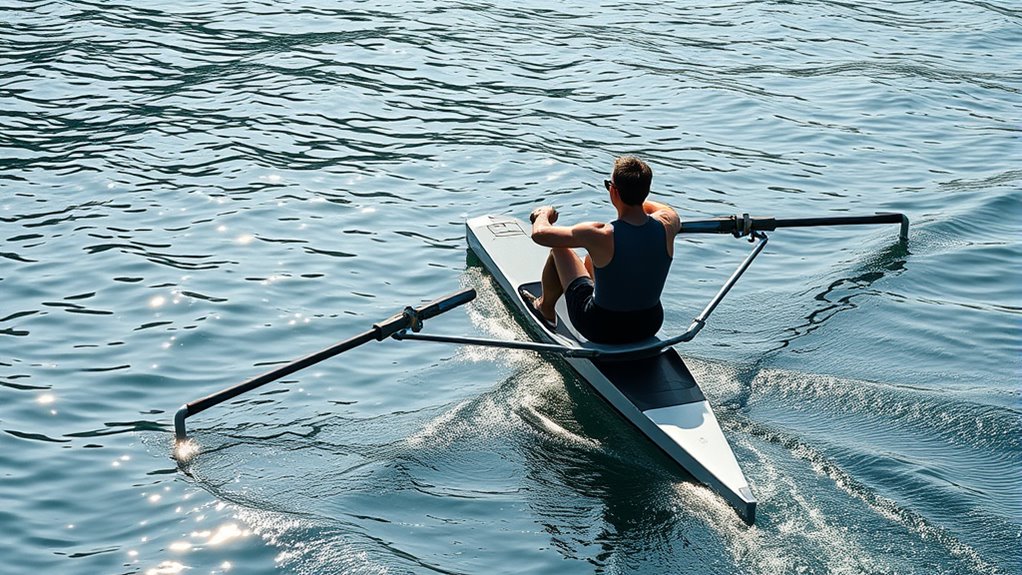
Once you’ve established good habits for consistent rowing form, applying those principles on the water and in the gym can profoundly boost your technique. Focus on maintaining a steady rhythm, syncing your movements smoothly from catch to recovery. In the gym, incorporate drills that emphasize proper posture and controlled movements, like pause drills at key points in the stroke. On the water, pay close attention to your boat’s balance and boat movement, ensuring your body stays aligned. Use mirrors or video recordings to analyze your form objectively. Consistent practice with awareness helps correct subtle errors and reinforces muscle memory. Remember, quality over quantity matters—prioritize precision and control to make every stroke more efficient and powerful.
How to Use Your Legs, Core, and Arms Effectively

To row efficiently, you need to coordinate your legs, core, and arms so they work together seamlessly. Your legs drive the power from the start, pushing against the foot stretcher to propel you forward. Your core stabilizes your body, transferring energy smoothly from your legs to your arms. Your arms then finish the stroke by pulling the handle toward your chest. To visualize this:
Coordinate legs, core, and arms for smooth, efficient rowing—push, stabilize, then pull for maximum power.
- Push hard with your legs, keeping your back straight
- Engage your core to transfer force upward
- Use your arms to pull the handle toward your chest
- Keep your shoulders relaxed and elbows close
- Reverse the motion smoothly during recovery
Focus on timing these movements correctly, so each part complements the others without wasted effort. Proper coordination maximizes efficiency and reduces fatigue.
Developing a Rhythm and Flow in Your Rowing Stroke

A smooth, rhythmic rowing stroke relies on coordinating your movements so they flow seamlessly from one to the next. To develop this rhythm, focus on timing each phase of your stroke, from catch to recovery. Keep your movements steady and controlled, avoiding abrupt or jerky motions. As you drive through the power phase, synchronize your leg push, core rotation, and arm pull smoothly. At the finish, release with purpose, then *shift* into the recovery with a relaxed, controlled return to the catch position. Maintaining a consistent pace helps establish a natural flow, making your stroke more efficient and less tiring. Over time, this rhythm becomes instinctive, allowing you to row with greater ease and steadiness.
Frequently Asked Questions
How Can I Mentally Visualize Each Phase to Improve Technique?
To mentally visualize each phase, picture yourself smoothly shifting through the motions. Imagine catching as reaching forward with a firm grip, then drive as powering through with your legs and back. Visualize finishing as pulling your hands towards your chest, then recovery as smoothly extending your arms and leaning forward. Focus on these images during your row, helping you stay precise, confident, and connected with each phase for better technique.
What Are the Signs of Fatigue Affecting Rowing Form?
Did you know that fatigue can reduce your rowing efficiency by up to 20%? When you’re tired, you might notice your shoulders hunch, your grip tighten, or your stroke length shorten. Your recovery could become rushed, and your posture may deteriorate. These signs indicate fatigue is impacting your form. Pay close attention, breathe steadily, and don’t push through pain—rest when needed to maintain proper technique and prevent injury.
How Does Breathing Coordination Influence Stroke Efficiency?
Breathing coordination greatly impacts your stroke efficiency by ensuring your muscles get enough oxygen and maintain rhythm. When you sync your breath with your rowing phases, you stay relaxed and avoid unnecessary fatigue. Inhale during the recovery to prepare for the drive, and exhale during the drive for power. This rhythm helps you conserve energy, maintain smooth movement, and maximize each stroke’s effectiveness, ultimately improving your overall rowing performance.
Can Equipment Adjustments Enhance My Rowing Form?
Yes, equipment adjustments can definitely enhance your rowing form. For instance, customizing foot stretcher positions ensures proper leg drive, while adjusting the damper setting helps control resistance, making your stroke more efficient. Properly fitted shoes and a well-set monitor can also keep your posture aligned. Experiment with these tweaks, and you’ll likely notice better stability, power, and comfort, leading to more effective and injury-free rowing sessions.
How Do Different Water Conditions Impact Proper Technique?
Different water conditions definitely impact your technique. On choppy water, you need to stabilize your body more and adjust your stroke to maintain balance. Calm water allows for smoother, more consistent movements, so focus on a steady rhythm. You might also need to modify your drive and recovery to adapt to waves or current. Paying attention to water conditions helps you stay efficient and avoid unnecessary strain or loss of control.
Conclusion
Mastering the rowing sequence transforms your stroke into a smooth, powerful wave. Picture yourself gliding effortlessly across the water, each phase flowing seamlessly into the next—catch, drive, finish, recovery—like ocean currents in harmony. As you build good habits and refine your technique, you’ll feel the rhythm and strength grow within you. Keep practicing, stay focused, and soon rowing will feel as natural as the tide, fueling your passion and progress.
Fall Picks
fall essentials
As an affiliate, we earn on qualifying purchases.