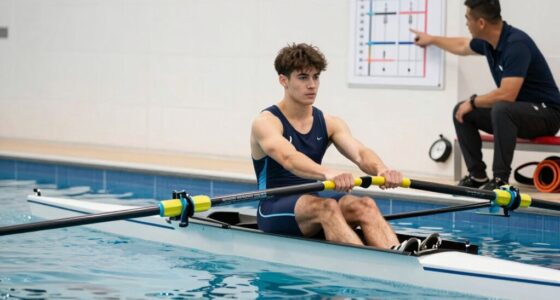

To instantly clean up sloppy rowing form, focus on the “legs, hips, arms” cue. This simple sequence guarantees you move smoothly through each stroke phase, preventing rushing or skipping steps. By consciously initiating each part in order, you’ll create more efficient, powerful strokes and avoid jerky movements. Mastering this cue helps you develop consistent technique and reduces energy waste. Keep exploring, and you’ll discover more ways to improve your rowing efficiency and safety.
Key Takeaways
- Use the “legs, hips, arms” cue to reinforce proper sequencing of movements.
- Slow down your stroke to focus on correct transition timing between phases.
- Visualize each movement as a continuous, dependent chain to improve flow.
- Prioritize initiating drive with your legs to establish a strong, controlled rhythm.
- Pay attention to muscle engagement to ensure proper form and quick correction of errors.
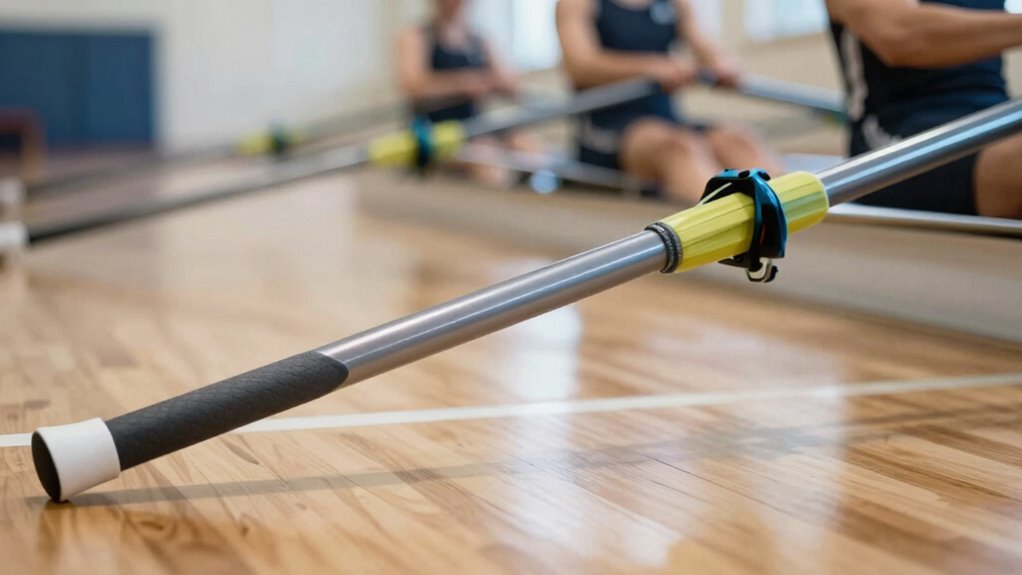
If your rowing form feels off or inconsistent, there’s a simple cue that can instantly improve your technique: focusing on your sequencing. Proper sequencing is essential because it guarantees each part of your stroke flows smoothly into the next, creating a more efficient and powerful movement. When you zero in on your sequencing, you’re more likely to catch and correct errors early, preventing sloppy form from becoming a habit. This is one of the most effective technique corrections you can make, especially when combined with coaching tips that emphasize the importance of timing and order in your stroke.
Focusing on your stroke sequencing ensures smoother, more powerful rowing—catch errors early and develop better technique effortlessly.
Start by breaking down your stroke into three main phases: the drive, the finish, and the recovery. During the drive, you push with your legs, lean back slightly, and then pull with your arms. The finish is where your arms are pulled in, and your torso is slightly leaned back. The recovery involves extending your arms forward, leaning your torso forward, and then bending your knees to slide back to the starting position. When your sequencing is correct, these phases happen in a fluid, rhythmic pattern, with each part leading smoothly into the next. If you notice your stroke feels jerky or disorganized, it’s often because you’re rushing or skipping steps.
A key coaching tip is to think of your stroke as a chain of movements, where each link depends on the one before it. Focusing on this chain helps you develop better technique correction, making your strokes more consistent. For example, during coaching sessions, coaches often remind rowers to initiate the drive with the legs before engaging the hips or arms. This order not only maximizes power but also guarantees your form stays aligned. When you consciously pay attention to the sequence, you prevent yourself from rushing through the phases and losing control of your movement.
Another tip is to use a mental cue: “legs, hips, arms.” Repeating this in your mind keeps you focused on the correct order of movements. If your form starts to slip, return to this cue and slow down your stroke to reinforce proper sequencing. Developing awareness of muscle engagement helps you stay in sync and ensures each phase builds on the previous one. Incorporating kinesthetic awareness can further enhance your ability to feel and control each part of the stroke, leading to more natural correction. As you become more mindful of each phase, you’ll notice a reduction in wasted energy, and your overall technique correction will become more natural. This simple focus on sequencing acts as an instant fix for sloppy form, helping you develop a smoother, more powerful rowing stroke that’s both effective and injury-free.

Chain Care Tool for Concept2 RowErg — Handle Holder & Lubing Helper for Rowing Machine Chain Maintenance, Inspection, and Oiling
- Handle Holder for Safe Maintenance: Securely holds handle in withdrawn position
- Prevents Handle Snap-Back: Ensures safe inspection and oiling
- Easy Setup and Stabilization: Quickly positions chain without tools
As an affiliate, we earn on qualifying purchases.
As an affiliate, we earn on qualifying purchases.
Frequently Asked Questions
How Long Does It Take to See Improvements Using This Rowing Cue?
You’ll start noticing improvements in your rowing technique within a few sessions. Consistent practice with this cue accelerates progress tracking and technique refinement. As you focus on applying it during workouts, your form becomes cleaner and more efficient in just a week or two. Keep monitoring your progress, and you’ll see steady gains in power, stamina, and overall rowing performance over the next few weeks.
Can Beginners Effectively Use This Cue Without Prior Rowing Experience?
Yes, beginners can effectively use this cue with some novice techniques and beginner tips. You should focus on keeping your movements controlled and mindful, breaking down each step of the rowing motion. The cue helps you develop proper form early on, making your workouts more efficient. Just start slow, practice regularly, and stay attentive to your technique—over time, you’ll see improvements and build confidence in your rowing skills.
Are There Specific Drills to Reinforce This Cue During Training?
Think of it like sharpening a sword—you need specific drills to reinforce proper form. You can use drill variations like pause drills, pause-and-shoot, or slow-row exercises to emphasize technique. Coaching techniques such as immediate feedback and visual cues help embed the cue into your muscle memory. These targeted drills challenge your awareness and consistency, transforming sloppy habits into crisp, efficient strokes, much like a master craftsman refining their craft.
Does This Cue Apply to All Rowing Machines and Watercraft?
This cue generally applies across most rowing machines and watercraft, but you should check machine compatibility first. On indoor rowers, focus on proper sequence and posture, while on watercraft, emphasize timing and core engagement. The cue helps improve form universally by reinforcing proper movement mechanics. Adjust your approach based on the device you’re using, but the core principle remains effective for ensuring efficient, safe rowing regardless of equipment.
What Common Mistakes Does This Cue Help Correct the Most?
Think of this cue as a master key that unlocks proper technique correction. It helps you fix common mistakes like overreaching or poor back alignment, which can lead to injury prevention and more efficient strokes. By focusing on this cue, you refine your form, ensuring each pull is smooth and controlled. This not only boosts your performance but also guards against strain, making your rowing safer and more effective.

Merach RS3 Scull Rowing Machine for Home, Simulate Real Row, Ergonomic Seat
- Realistic Sculls-Style Rowing: 120° arm motion for full chest expansion
- Multiple Rowing Modes: One-arm, alternating, and dual-arm pulls
- Magnetic Resistance System: Up to 80 lbs with 16 adjustable levels
As an affiliate, we earn on qualifying purchases.
As an affiliate, we earn on qualifying purchases.
Conclusion
Think of your rowing form as a delicate dance, where each move must be precise to keep the rhythm flowing smoothly. That cue acts like a gentle spotlight, illuminating and correcting your steps instantly. When you focus on it, your technique sharpens, and sloppiness fades like shadows at dawn. Embrace this cue as your guiding star—keeping your rhythm steady and your form flawless, turning every stroke into a graceful, powerful performance on the water.

Rowing Training Log and Diary: Rowing Training Journal and Book For Rower and Coach – Rowing Notebook Tracker
As an affiliate, we earn on qualifying purchases.
As an affiliate, we earn on qualifying purchases.

Faster Masters Rowing Episode 1: Rowing Technique for Masters: Includes detailed description of Sweep rowing technique; Sculling technique
As an affiliate, we earn on qualifying purchases.
As an affiliate, we earn on qualifying purchases.