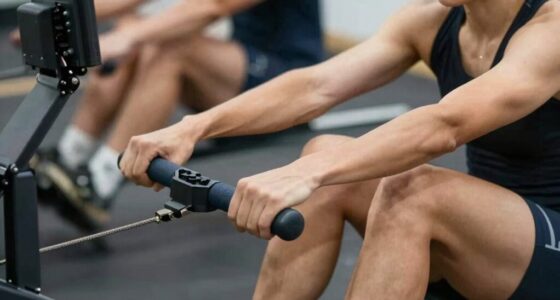
When you row for time, you focus on maintaining a steady effort, which creates a consistent, rhythmic feel that tests your endurance and mental strength. In contrast, rowing for distance pushes you to go all-out in short bursts, then recover, making it more intense and variable. These different approaches influence how your muscles feel and how you stay motivated. To understand the unique effects of each, you’ll want to explore how they shape your workout experience further.
Key Takeaways
- Time-based rowing emphasizes sustained effort and muscle endurance, leading to a steady, rhythmic physical and mental experience.
- Distance rowing involves short bursts of maximum effort followed by recovery, creating intense, fluctuating muscle fatigue.
- Maintaining a consistent pace in time workouts requires mental focus and resilience, unlike adjusting speed dynamically in distance workouts.
- Distance rowing encourages strategic pacing and decision-making, while time rowing promotes steady, continuous effort.
- The physical sensations differ: time rowing produces a uniform burn, whereas distance rowing can cause rapid, localized fatigue.

When it comes to rowing workouts, deciding whether to focus on time or distance can considerably impact your training goals and results. Both approaches challenge your body and mind differently, and understanding these differences helps you optimize your effort. Rowing for time tends to emphasize muscle engagement and endurance, pushing you to maintain a steady effort over a set period. As you row against the clock, your muscles—especially in your legs, core, and back—work continuously to sustain your pace. This sustained effort demands a high level of mental focus, as you need to stay consistent, resist fatigue, and manage your breathing throughout the session. Your mind becomes a key player, helping you push through discomfort and keep output steady amid physical fatigue. Additionally, time-based workouts can cultivate mental resilience, training you to stay committed even during challenging moments.
On the other hand, rowing for distance shifts your focus toward speed and efficiency. When you aim to cover a certain number of meters or kilometers, your muscles are engaged in short bursts of power followed by recovery, depending on your pacing strategy. This approach often encourages you to apply maximum force during each stroke, which can lead to different muscle engagement patterns compared to time-based training. Your body learns to optimize each stroke to cover the most ground quickly, but this can also mean more rapid fatigue in specific muscle groups. Mentally, rowing for distance demands a different kind of focus. You need to gauge your effort, adjust your pace on the fly, and remain motivated to beat your previous records or reach your target faster. It’s a dynamic mental task that involves quick decision-making and strategic pacing. Furthermore, this method can help develop pacing skills, essential for improving overall rowing performance.
The feeling of effort during each method also varies. When rowing for time, you might notice a more uniform, sustained burn, as your muscles work steadily without large fluctuations in intensity. Conversely, rowing for distance can introduce moments of intense effort followed by brief recovery, creating a different rhythm in your muscles and mind. You might feel more adrenaline during a distance push, whereas time-based workouts often promote a meditative, rhythmic state. Both methods challenge your mental focus, but in unique ways—either maintaining consistency over time or managing fluctuating effort to maximize distance.
Ultimately, whether you prefer one over the other depends on your goals. Time-based rowing hones endurance and mental resilience, while distance-focused sessions sharpen speed and power. Recognizing how each influences muscle engagement and mental focus helps you tailor your workouts to meet specific needs, making your training more effective and engaging.

Beginner Indoor Rowing Program – 8 Weeks – A Simple 8-Week Training Plan to Build Endurance, Technique and Confidence on the Rowing Machine
As an affiliate, we earn on qualifying purchases.
As an affiliate, we earn on qualifying purchases.
Frequently Asked Questions
How Does Pacing Differ Between Time-Based and Distance-Based Rowing?
When rowing for time, you focus on pacing consistency, maintaining a steady effort throughout the session. You manage your energy to avoid burnout, often adjusting your stroke rate to stay on target. In contrast, rowing for distance requires you to set a consistent pace that you can sustain over a specific length. Your goal is to optimize energy management across the entire distance, balancing speed and stamina for an efficient workout.
Which Approach Is Better for Beginners—Time or Distance?
For beginners, focusing on time is often better because it simplifies rowing techniques and equipment considerations. When you row for a set time, you can concentrate on maintaining steady pace, improving form, and building endurance without stressing over exact distances. This approach helps you develop consistent rowing habits, adapt equipment gradually, and avoid burnout. As your skills grow, switch to distance to challenge yourself and track progress more precisely.
How Do Motivation Levels Vary When Rowing for Time Versus Distance?
When rowing for time, your motivation often stays steady because you focus on maintaining mental focus and pushing through each second. With distance, motivation can fluctuate as goal clarity varies—some days you might feel motivated to reach a specific number, while other days, it’s harder to stay engaged. Overall, rowing for time encourages consistent mental focus, making it easier to stay motivated, whereas distance challenges your goal clarity and can impact your drive.
Can You Mix Time and Distance Objectives in Training?
Yes, you can mix time and distance objectives in training. Incorporate interval training to challenge your performance metrics, alternating between rowing for specific time intervals and covering set distances. This approach helps improve both endurance and pace, keeping your workouts engaging and balanced. By varying your focus, you can push your limits and track progress more effectively, leading to better overall rowing performance.
How Does Fatigue Impact Performance Differently in Each Method?
When fatigue hits, you’ll find yourself in a circus of endurance challenges, desperately clinging to mental resilience. In timed rows, fatigue sneaks up, making you question if you can hold on. In distance rows, it’s a marathon of mental grit, testing your resolve. Either way, fatigue’s comedy show pushes your limits, demanding you stay sharp and committed, proving that mental resilience is your secret weapon against the chaos of exhaustion.

YPOO Rowing Machine for Home, 350 LB Capacity, 16-Level Silent Resistance, Magnetic Rowing Machines for Home Foldable, Full-Body Workout Compact Rowing Machine for Cardio & Strength with APP Support
【Power & Silent Magnetic Resistance】Enjoy powerful and quiet workouts with the YPOO Magnetic Rowing Machine. Featuring 99 lbs…
As an affiliate, we earn on qualifying purchases.
As an affiliate, we earn on qualifying purchases.
Conclusion
So, next time you hop on the rower, embrace the challenge of both rowing for time and distance. Sure, pushing for a set time can feel relentless, but it’s also like chasing a fleeting breeze—you keep going, knowing each stroke gets you closer. Don’t let the difficulty scare you; instead, picture yourself slicing through water, steady and unstoppable. With each session, you’ll build endurance and confidence, transforming those tough moments into your greatest victories.
YPOO Rowing Machine for Home, 350 LB Capacity, 16-Level Silent Resistance, Magnetic Rowing Machines for Home Foldable, Full-Body Workout Compact Rowing Machine for Cardio & Strength with APP Support
【Power & Silent Magnetic Resistance】Enjoy powerful and quiet workouts with the YPOO Magnetic Rowing Machine. Featuring 99 lbs…
As an affiliate, we earn on qualifying purchases.
As an affiliate, we earn on qualifying purchases.
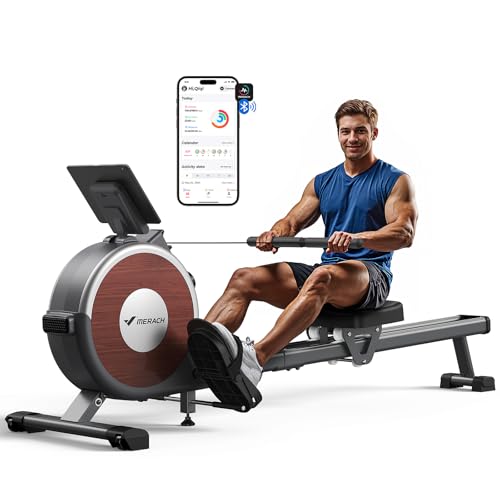
Merach Rowing Machine, Magnetic Rower Machine for Home, 16 Levels of Quiet Resistance, Dual Slide Rail with Max 350lb Weight Capacity, App Compatible with LCD Monitor, Q1S
MERACH APP: Our App offers various courses and programmed exercises for you, Taking the courses can bring your…
As an affiliate, we earn on qualifying purchases.
As an affiliate, we earn on qualifying purchases.